

On June 1, 1974, a short article appeared in the journal Emergency Medicine offering a remarkably simple answer to one of the most terrifying medical emergencies imaginable. A person eating dinner suddenly clutched his throat. He could not speak. He could not breathe. Within minutes, unless someone intervened, he could die at the table while the people around him watched helplessly.
The article, written by Cincinnati surgeon Dr. Henry J. Heimlich, carried the memorable title “Pop Goes the Café Coronary.” The phrase reflected a common misunderstanding. When a diner suddenly collapsed in a restaurant, witnesses often assumed that the victim had suffered a heart attack. In many cases, however, the cause was not a coronary event at all. A piece of food had become lodged in the airway, cutting off oxygen to the lungs and brain.
Heimlich believed that the standard response was inadequate. A choking victim could not wait for an ambulance. Nor could rescuers depend upon specialized medical equipment. The answer had to be immediate, easy to remember, and simple enough that an ordinary person could perform it under intense pressure.
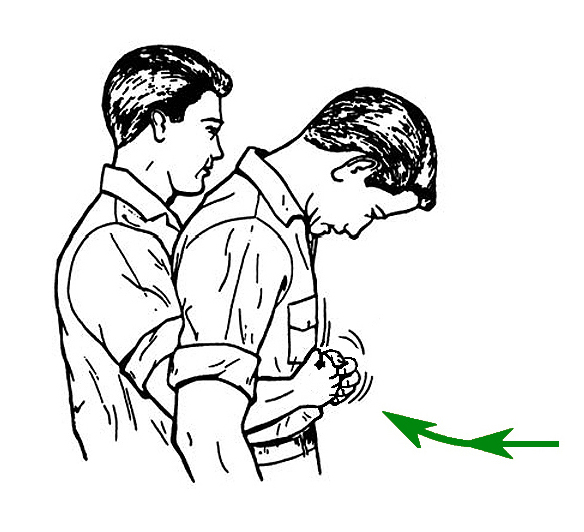
His proposed method was direct. A rescuer should stand behind the victim, place a fist above the navel and below the rib cage, grasp the fist with the other hand, and deliver a forceful upward thrust into the abdomen. The compression would push the diaphragm upward, forcing air from the lungs and creating enough pressure to expel the obstruction from the windpipe.
The idea was powerful because it turned the victim’s own lungs into an emergency tool. Heimlich compared the method to popping a cork from a bottle. If the trapped air could be compressed sharply enough, the obstruction might be driven out before the victim lost consciousness.
The maneuver spread with astonishing speed. Newspapers began reporting cases in which diners, family members, and restaurant workers used the technique successfully. Within weeks, the method had entered the public imagination. It soon became known simply as the Heimlich maneuver, one of the rare medical procedures recognized by the name of its inventor far beyond hospitals and doctors’ offices.
Its popularity also reflected a broader change in American medicine. During the 1960s and 1970s, lifesaving techniques once considered the province of trained professionals increasingly became part of public education. Cardiopulmonary resuscitation, or CPR, taught ordinary citizens how to respond to cardiac arrest. The Heimlich maneuver offered a comparable response to choking: a moment when hesitation could prove fatal, but a few seconds of informed action could preserve a life.
The method was not without controversy. Heimlich strongly opposed the use of back blows, arguing that they could push an obstruction deeper into the airway. Over time, major medical organizations adopted a more combined approach. Current guidance generally recommends beginning with five back blows for a conscious choking adult or child and then using five abdominal thrusts if the object remains lodged. Infants require a different technique, using back blows and chest thrusts rather than abdominal thrusts.

Even with those changes, Heimlich’s central achievement remains intact. He forced the medical profession and the public to recognize choking as a distinct and urgent emergency. More importantly, he gave millions of people a practical method for responding to it.
The legacy of the Heimlich maneuver lies not merely in its mechanics, but in its democratization of lifesaving knowledge. A restaurant patron, a parent, a teacher, or a stranger no longer had to remain a powerless witness. With a few decisive movements, almost anyone could become the person who stood between an ordinary accident and an avoidable death.