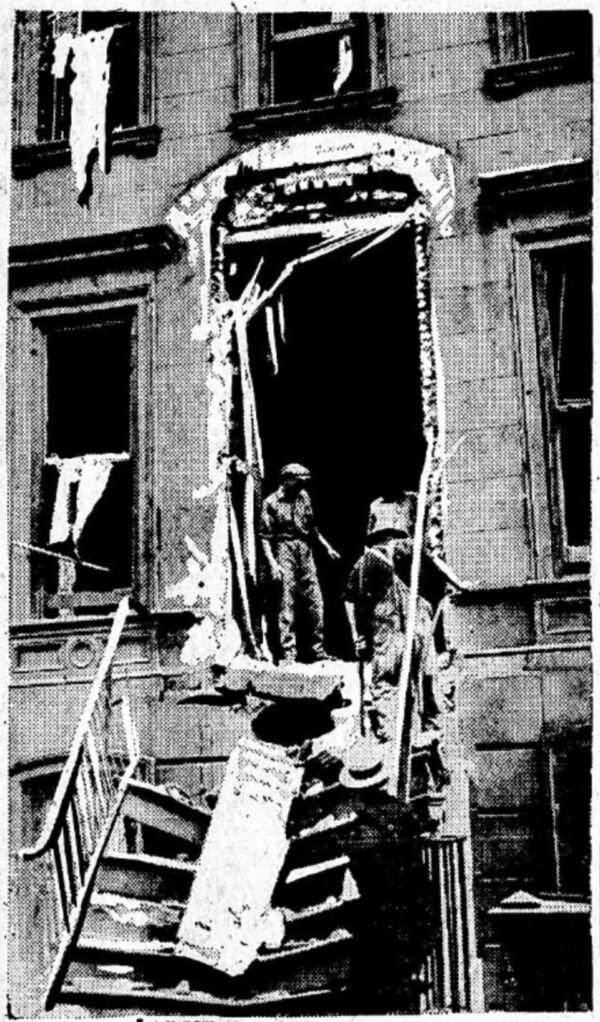
Shortly before midnight on June 2, 1919, a powerful explosion tore through the Washington, D.C., home of Attorney General A. Mitchell Palmer. The blast shattered windows, damaged neighboring houses, and ripped apart the front of Palmer’s residence. Palmer, his wife, and their young daughter survived. The man carrying the device did not. Carlo Valdinoci, a militant anarchist, was killed when the bomb detonated prematurely as he approached the house.
The attack was not an isolated act of violence. It was part of a coordinated bombing campaign that struck eight American cities almost simultaneously. Nine bombs were planted at carefully selected locations, targeting judges, politicians, law-enforcement officials, business leaders, and others viewed by the attackers as representatives of the existing political and economic order. The blasts stretched from Boston and New York to Pittsburgh, Cleveland, Philadelphia, Paterson, New Jersey, and Washington.
The bombing of Palmer’s home became the most widely remembered attack because of the attorney general’s position as the nation’s chief law-enforcement officer. Franklin and Eleanor Roosevelt, who lived across the street at the time, were also shaken by the explosion. But the broader significance of the night lay in the scale of the operation. The perpetrators were not merely attempting to kill individual officials. They were trying to demonstrate that a revolutionary movement could reach prominent targets across the country within a matter of minutes.
Investigators searching the wreckage found scraps of a pink leaflet titled “Plain Words.” Copies had been left at the other bombing sites as well. The pamphlet declared war on the institutions of law, government, and capitalism. Its language helped federal investigators connect the attacks to followers of Luigi Galleani, an Italian anarchist who advocated revolutionary violence. His supporters, known as Galleanists, had already been linked to previous acts of political terrorism.
The June bombings followed an earlier wave of attempted attacks in late April. Anarchists mailed dozens of explosive packages to public officials and business leaders, including John D. Rockefeller and Seattle Mayor Ole Hanson. One device exploded at the home of former Georgia Sen. Thomas Hardwick, severely injuring a domestic worker. A postal employee in New York intercepted additional packages before they could reach their intended victims.
The timing magnified the public fear. The United States had emerged from World War I into a period of intense political uncertainty. The Bolshevik Revolution in Russia had convinced many Americans that radical movements might spread westward. Labor unrest, inflation, unemployment, and the lingering effects of the influenza pandemic added to the sense that the country was entering a dangerous era. The bombings appeared to confirm the darkest suspicions of those who believed revolutionary violence had taken root inside the United States.
Palmer responded by expanding the federal government’s effort to identify and deport radicals. He created an intelligence division and placed a young Justice Department lawyer named J. Edgar Hoover in charge. The Bureau of Investigation, the predecessor of the FBI, received new resources as officials attempted to track down the bombers. Investigators used fragments of clothing, train tickets, pamphlets, and even part of Valdinoci’s scalp to reconstruct the Washington attack.

The government’s response soon extended far beyond the perpetrators. During the Palmer Raids of 1919 and 1920, authorities arrested thousands of suspected radicals and immigrants in operations later criticized for poor planning, weak evidence, and violations of constitutional rights. No other June bombers were directly identified.
The bombings of June 2, 1919, therefore became a turning point in American political history. They exposed a genuine threat of domestic terrorism.