On October 10, 1913, President Woodrow Wilson pressed a telegraph key in Washington, D.C., sending an electrical signal across more than 2,000 miles that detonated dynamite charges deep in the jungles of Panama. The explosion tore through the Gamboa Dike, the last barrier separating the waters of the Atlantic and Pacific, and symbolically completed one of the most ambitious engineering projects in human history—the Panama Canal. Though the first ships would not pass through the waterway until the following year, Wilson’s simple act of triggering the blast marked the moment the two oceans were finally united.
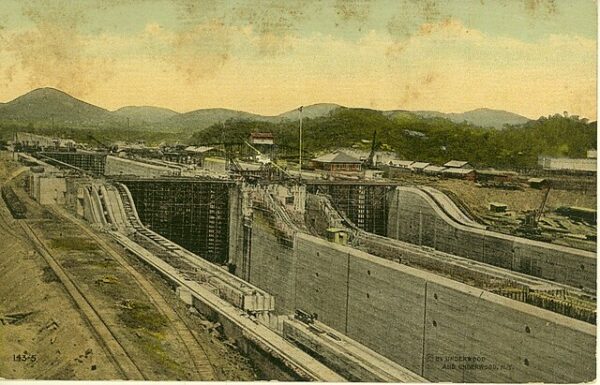
The Gamboa Dike had been built to separate the waters of the Chagres River and Culebra Cut, the great artificial channel slicing through Panama’s mountainous spine. For nearly a decade, thousands of engineers, laborers, and contractors—working under grueling tropical heat and plagued by disease—had excavated more than 200 million cubic yards of rock and earth. The final demolition of the dike allowed the waters of Gatun Lake to flow freely into the cut, flooding the canal to its operational depth. As the dike vanished in a thunderous explosion and a surge of muddy water, the vision of connecting two oceans was at last realized.
The canal’s completion was the culmination of a monumental effort spanning decades, fraught with false starts and international drama. The French had first attempted to dig a canal through Panama in the 1880s under Ferdinand de Lesseps, the builder of the Suez Canal, but malaria, yellow fever, and financial mismanagement led to catastrophe and bankruptcy. When the United States took control of the project in 1904—after backing Panama’s independence from Colombia—the challenge was to make the dream succeed where the French had failed. Under the leadership of engineers John Stevens and later George Washington Goethals, American ingenuity and public health reforms transformed the effort. Sanitation campaigns led by Dr. William Gorgas eradicated mosquitoes and reduced deadly disease, while the construction of massive locks and dams turned the mountainous isthmus into a navigable waterway.
By 1913, the United States had spent more than $350 million—the largest construction expenditure in history at the time—and employed over 40,000 workers from around the world. The canal’s opening would cut the voyage between New York and San Francisco by more than 8,000 miles, reshaping global trade routes and altering naval strategy for generations. The United States now stood astride a new maritime crossroads, able to project power across both oceans with unprecedented speed.
Wilson’s role in the event reflected his characteristic idealism tempered by a quiet sense of destiny. Unlike Theodore Roosevelt, who had championed and overseen much of the canal’s construction and considered it his crowning achievement, Wilson did not travel to Panama or stage a public ceremony. Instead, from the White House, he sent the signal that detonated the charges, underscoring the notion that technology and progress could link nations and continents through peaceful enterprise. Yet the canal also embodied American imperial ambition: the U.S. maintained sovereignty over the Canal Zone for nearly the entire twentieth century, sparking resentment among Panamanians and Latin American neighbors.

The successful breach of the Gamboa Dike was met with worldwide acclaim. Newspapers celebrated it as the “wedding of the oceans,” an engineering miracle rivaling the Great Wall of China and the pyramids. But beneath the triumph lay a sobering human cost—more than 25,000 workers, mostly West Indian laborers, had died during the French and American phases of construction. Their graves lined the hills overlooking the gleaming locks, silent witnesses to progress built on sacrifice.
When the Panama Canal officially opened on August 15, 1914—just days after the outbreak of World War I—it stood as a paradox of the age: a symbol of peace and commerce created through imperial power and human toil. Wilson’s telegraph key, now preserved in the Smithsonian Institution, remains a relic of that pivotal moment when a single spark of electricity bridged continents and oceans, heralding a new era of global connection.