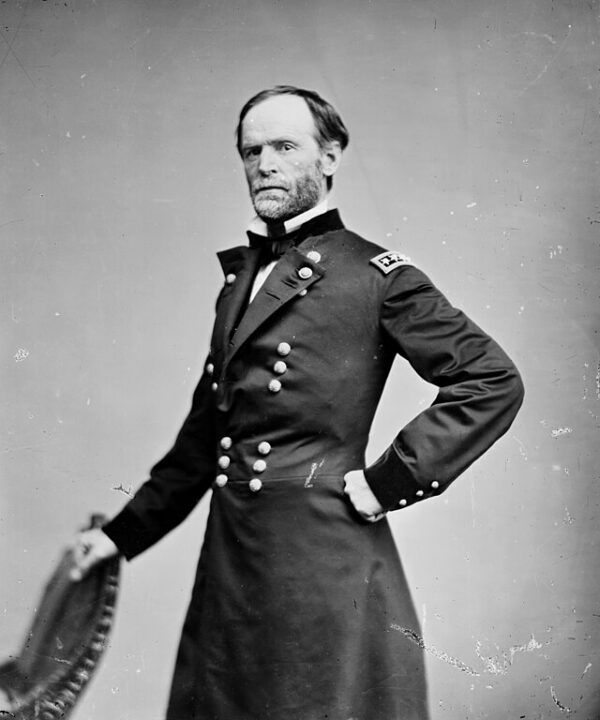
On December 22, 1864, one of the most consequential campaigns of the American Civil War reached its dramatic conclusion when Savannah, Georgia, fell to Union forces under the command of William Tecumseh Sherman. Days later, Sherman sent a succinct but unforgettable message to Abraham Lincoln: “I beg to present you as a Christmas gift the city of Savannah.” The capture of the coastal city marked the triumphant end of Sherman’s March to the Sea and underscored a decisive shift in the war’s momentum.
Savannah’s fall followed one of the most audacious military movements in American history. After capturing Atlanta in September 1864, Sherman severed his supply lines and led roughly 60,000 men of the Army of the Tennessee and allied forces on a 285-mile march across Georgia. Rather than seeking pitched battles, Sherman pursued a strategy of systematic destruction aimed at the Confederacy’s economic and psychological capacity to wage war. Railroads were twisted into “Sherman’s neckties,” crops and livestock were seized or destroyed, and plantations were rendered unusable. The march demonstrated that Confederate armies could no longer protect their own heartland.
By early December, Sherman’s columns approached Savannah, a vital port city protected by Confederate fortifications and natural barriers of swamps and rivers. Confederate General William J. Hardee commanded roughly 10,000 troops, far outnumbered and increasingly isolated. Sherman encircled the city, cutting off escape routes and supply lines while positioning heavy artillery to threaten bombardment. Crucially, Union forces captured Fort McAllister on December 13, reopening Sherman’s communications with the U.S. Navy and ensuring a steady flow of supplies.
Recognizing the futility of prolonged resistance, Hardee evacuated Savannah on the night of December 20–21, slipping his troops across the Savannah River into South Carolina. When Union troops entered the city the following day, they found it largely intact. Unlike Atlanta, which had suffered extensive destruction, Savannah was spared major damage—an outcome influenced by Sherman’s desire to preserve a valuable port and by the city’s relatively bloodless surrender.
Sherman’s message to Lincoln was more than a flourish of holiday rhetoric. Savannah’s capture delivered tangible military and political benefits at a critical moment. The city provided the Union with a deep-water port, 25,000 bales of cotton, and a secure base for further operations. Just as importantly, it reinforced Northern morale following Lincoln’s reelection in November and validated the administration’s hard-war strategy. Sherman’s success demonstrated that the Confederacy was being squeezed not only on the battlefield but in its economic and social foundations.

The fall of Savannah also signaled what was to come. With Georgia effectively broken, Sherman soon turned his attention northward, launching the Carolinas Campaign in early 1865. The psychological impact of the march—its proof that Confederate territory could be traversed and dismantled at will—accelerated the erosion of Southern civilian support for the war and hastened the Confederacy’s collapse.
For Lincoln, Sherman’s “Christmas gift” arrived as both a strategic prize and a symbolic vindication. It affirmed the Union’s inexorable advance and the effectiveness of total war in bringing the conflict to a close. Less than four months later, Confederate General Robert E. Lee would surrender at Appomattox Court House.