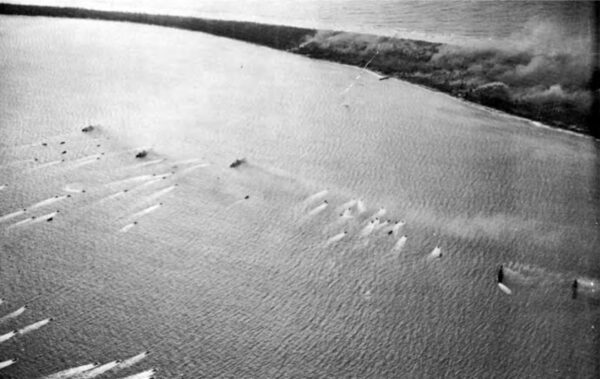
On February 17, 1944, U.S. forces launched a decisive assault on the Eniwetok Atoll in the Marshall Islands, marking another critical step in the Central Pacific drive toward Japan. The operation—part of a broader campaign following the capture of Kwajalein earlier that month—reflected the evolving American strategy of “island hopping,” designed to seize key strongholds while bypassing heavily fortified positions.
Eniwetok, a remote coral atoll composed of more than 40 small islands, held outsized strategic value. Its location placed it within striking distance of the Mariana Islands, which American planners viewed as the next major objective. Control of Eniwetok would provide a forward naval base and airfields capable of supporting long-range bombing operations deeper into Japanese-held territory. The atoll also offered a protected lagoon suitable for anchoring warships and staging further offensives.
The battle opened with intense naval and aerial bombardment. In the weeks prior, U.S. forces had already demonstrated overwhelming superiority in the region. American carrier-based aircraft and land-based bombers pounded Japanese installations, while warships shelled defensive positions. The objective was clear: soften resistance before Marines and Army troops went ashore.
Major General Thomas E. Watson commanded the V Amphibious Corps landing force, which included elements of the 4th Marine Division and the U.S. Army’s 106th Infantry Regiment. Their first target was Engebi Island, located on the northern edge of the atoll. On the morning of February 17, Marines stormed the beaches under covering fire. Japanese defenders, though significantly outnumbered and cut off from reinforcement, fought tenaciously from prepared positions, including bunkers and concealed foxholes carved into the sandy terrain.
The fighting on Engebi was brutal but swift. By the end of the first day, American forces had largely secured the island, though isolated pockets of resistance continued to erupt. The pattern would repeat itself across the atoll’s key islands—Eniwetok Island itself and Parry Island—over the following days.
The Japanese garrison at Eniwetok numbered roughly 3,500 troops, many of whom had only recently arrived and had limited time to fortify their defenses. Unlike earlier battles such as Tarawa, where entrenched defenders exacted heavy American casualties, the rapid pace of U.S. operations in early 1944 left Japanese forces scrambling to prepare. Nevertheless, the defenders adhered to Tokyo’s broader doctrine of inflicting maximum casualties and fighting to the death.
On February 19, U.S. troops landed on Eniwetok Island, encountering stiff resistance in the island’s interior. Dense underbrush and hidden fortifications complicated the advance. Engineers and infantry units worked in tandem, using flamethrowers, demolition charges, and coordinated assaults to root out entrenched defenders. Two days later, on February 21, American forces attacked Parry Island, the final major objective. Heavy pre-invasion shelling from battleships—including concentrated bombardment that dwarfed earlier Pacific operations—proved decisive in breaking organized resistance.
By February 22, the atoll was declared secure. The cost of victory was significant but comparatively lighter than some earlier Pacific engagements: approximately 348 Americans were killed, and around 866 wounded. Japanese losses were far heavier, with nearly the entire garrison killed and only a handful captured.

The capture of Eniwetok marked a turning point in the Central Pacific campaign. With the Marshall Islands effectively neutralized, the United States had secured a forward operating base less than 1,000 miles from the Mariana chain. Within months, American forces would launch operations against Saipan, Tinian, and Guam—battles that would bring U.S. B-29 bombers within range of the Japanese home islands.
Strategically, Eniwetok demonstrated the increasing efficiency of American amphibious warfare. Improved coordination between naval bombardment, air power, and ground forces reduced casualties and accelerated the tempo of operations. It also underscored the narrowing defensive perimeter facing Japan as Allied forces advanced steadily westward across the Pacific.