
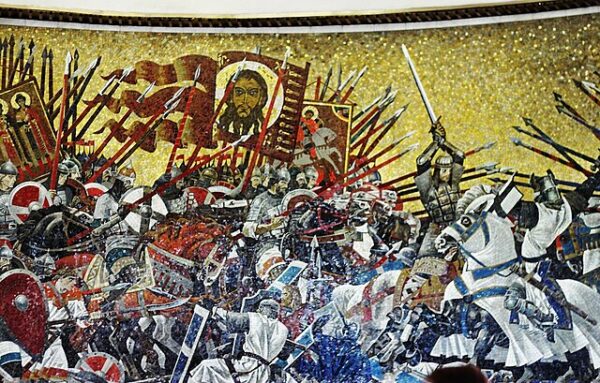
On April 5, 1242, one of medieval Europe’s most dramatic confrontations unfolded across the frozen expanse of Lake Peipus. Known as the Battle on the Ice, the clash pitted the forces of Alexander Nevsky, prince of Novgorod, against the advancing armies of the Teutonic Knights. The outcome would resonate far beyond the battlefield, shaping the religious, cultural, and political trajectory of Eastern Europe.
The conflict emerged from a broader struggle between expanding Western Christendom and the Orthodox East. In the early 13th century, Catholic military orders—particularly the Teutonic Knights—sought to extend their influence into the Baltic and Russian lands, combining crusading zeal with territorial ambition. Their campaigns were not merely military but ideological, aiming to bring Orthodox Slavic populations under the authority of Rome. Against this backdrop, Novgorod and its allies faced mounting pressure from both western crusaders and eastern threats, including the Mongols.
Alexander Nevsky, already a proven commander following his victory over Swedish forces at the Battle of the Neva in 1240, emerged as a central figure in resisting western incursions. Recognizing the strategic importance of mobility and terrain, Nevsky avoided direct confrontation until conditions favored his forces. That opportunity came in early April 1242, when the icy surface of Lake Peipus provided an unconventional but decisive battleground.
The Teutonic Knights, heavily armored and trained in shock cavalry tactics, advanced across the frozen lake in tight formation, expecting to overwhelm the lighter Russian troops. Nevsky, however, deployed his forces with careful calculation. His infantry formed a defensive center, while cavalry units were positioned on the flanks, ready to encircle the enemy once their momentum faltered.
As the battle commenced, the knights drove into the Russian center, initially gaining ground. But the terrain—slick, unstable ice—hampered their effectiveness. The weight of their armor and the rigidity of their formation limited maneuverability, while Nevsky’s forces exploited these constraints. Russian cavalry swept in from the sides, gradually encircling the knights and disrupting their cohesion.
Accounts of the battle often emphasize the dramatic image of knights falling through the ice, though historians debate the extent of such घटनाओं. What is clear is that the Teutonic advance collapsed under sustained pressure. Surrounded and unable to regroup, the knights were forced into retreat, suffering significant losses in the process. The frozen lake, once a pathway for invasion, became a trap.

The victory was decisive. It halted the eastward expansion of the Teutonic Knights and secured Novgorod’s independence at a critical moment. More broadly, it marked a turning point in the contest between Catholic and Orthodox spheres of influence in the region. Nevsky’s success ensured that much of northwestern Russia would remain aligned with Eastern Orthodoxy rather than being drawn into the orbit of Western Christendom.
In the centuries that followed, the Battle on the Ice assumed a near-mythic status in Russian historical memory. Alexander Nevsky was later canonized as a saint by the Russian Orthodox Church, and his victory came to symbolize resistance against foreign domination. The battle was immortalized in chronicles, art, and, in the 20th century, famously dramatized in Sergei Eisenstein’s film Alexander Nevsky, where it was framed as a timeless defense of the homeland.