
On April 17, 1970, the crew of Apollo 13 returned safely to Earth, concluding one of the most dramatic and closely watched episodes in the history of human spaceflight. What began as a routine mission to the Moon had, within days, become a test of engineering ingenuity, human endurance, and the limits of crisis management in the early space age.
Launched on April 11 from Kennedy Space Center, Apollo 13 was intended to be the third mission to land astronauts on the lunar surface. Commanded by James A. Lovell, with command module pilot Jack Swigert and lunar module pilot Fred Haise, the mission initially proceeded without incident. The spacecraft, composed of the command module Odyssey and the lunar module Aquarius, was on course for a landing in the Fra Mauro region of the Moon.
That trajectory—and the mission’s purpose—changed abruptly on April 13, when an oxygen tank in the service module exploded approximately 200,000 miles from Earth. The blast crippled the spacecraft, cutting off oxygen supplies and disabling the fuel cells that provided electrical power. In a now-famous transmission, Swigert reported to mission control in Houston, “Houston, we’ve had a problem,” a phrase that would become synonymous with calm under pressure.
The explosion forced NASA to abandon the lunar landing and pivot immediately to a rescue operation. Engineers and flight controllers at NASA worked around the clock to devise procedures that had never been tested in flight. The astronauts powered down the command module to conserve energy and moved into the lunar module, which became a lifeboat for the remainder of the journey.
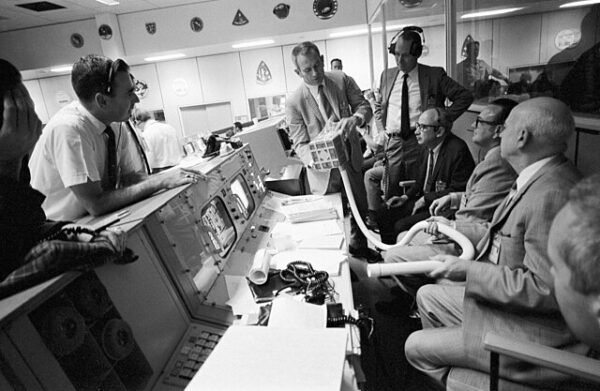
The challenges were immense. With limited power, water, and oxygen, the crew had to navigate a trajectory that would loop them around the Moon and back toward Earth. Carbon dioxide levels began to rise dangerously inside the spacecraft, requiring an improvised solution: engineers on the ground devised a way to adapt square command module filters to fit the lunar module’s round openings, using only materials available on board. The fix, assembled by the astronauts in zero gravity, proved successful.
Throughout the ordeal, precise calculations were essential. Small engine burns had to be executed manually to correct the spacecraft’s course, often using the Earth’s position in the window as a guide. Any significant error could have sent Apollo 13 drifting irretrievably into space or reentering Earth’s atmosphere at a fatal angle.
As the spacecraft approached Earth, another critical phase loomed. The command module, which had been powered down for days in the frigid vacuum of space, had to be reactivated for reentry. Engineers carefully sequenced the power-up procedure to avoid overloading the limited electrical systems. The crew then transferred back from the lunar module—jettisoning Aquarius after it had served its purpose—and prepared for descent.
Reentry itself carried significant risk. The heat shield, which had been exposed to debris from the explosion, was of uncertain integrity. Communications blackout during atmospheric entry—normally lasting a few minutes—stretched longer than expected, heightening anxiety among controllers and the millions watching around the world.

Finally, at 1:07 p.m. Eastern Time on April 17, Apollo 13’s command module splashed down safely in the South Pacific Ocean, near American Samoa. Recovery forces, including the USS Iwo Jima, quickly reached the capsule and secured the crew. Lovell, Swigert, and Haise emerged exhausted but unharmed, having endured nearly four days of crisis conditions in space.
The safe return of Apollo 13 was widely hailed as a “successful failure” for NASA. Although the mission did not achieve its original objective of landing on the Moon, it demonstrated the resilience of both the astronauts and the thousands of individuals on the ground who worked to bring them home. The episode prompted extensive reviews of spacecraft design and safety protocols, leading to modifications that would improve subsequent missions.
In the broader context of the Apollo program, Apollo 13 marked a turning point. It underscored the inherent dangers of space exploration even as it showcased the capacity to overcome them. The mission’s legacy endures not only in technical lessons but in its enduring example of problem-solving under extreme pressure—a testament to American ingenuity at a moment when failure seemed all but certain.