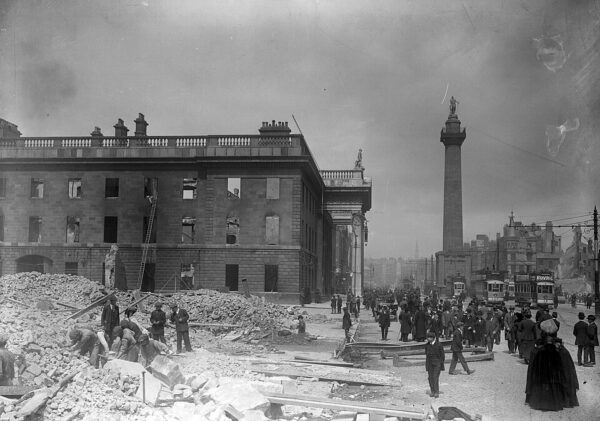
The Easter Rising reached its decisive conclusion on April 29, 1916, after nearly a week of intense urban combat that transformed central Dublin into a battlefield and reshaped the trajectory of Irish nationalism. What began on Easter Monday as a bold, if precarious, insurrection against British rule ended in surrender, but not in failure of historical consequence. The rebellion’s final hours revealed both the limits of its immediate military prospects and the depth of its long-term political significance.
From the outset, the Rising had been marked by confusion, fragmentation, and uneven support. Planned by a coalition of Irish Republican Brotherhood leaders, members of the Irish Volunteers, and the Irish Citizen Army, the rebellion aimed to seize key positions in Dublin and proclaim an independent Irish Republic. Yet a countermanding order issued by Eoin MacNeill, the nominal head of the Volunteers, severely reduced turnout, leaving the insurgents far fewer in number than anticipated. Despite this, approximately 1,200 rebels mobilized, occupying strategic buildings including the General Post Office (GPO), which served as headquarters under Patrick Pearse, a poet.
Over the next six days, British forces—initially caught off guard—rapidly reinforced their presence in Dublin, eventually deploying more than 16,000 troops, supported by artillery and even a naval gunboat positioned on the River Liffey. The imbalance in manpower and firepower soon became overwhelming. British shelling devastated large sections of the city center, igniting fires that consumed entire blocks and inflicted severe damage on civilian infrastructure. The GPO itself was reduced to a burning shell, forcing rebel leaders to evacuate and establish a new command position in nearby Moore Street.
By the final days of the uprising, the situation for the rebels had become untenable. Supplies were dwindling, communication between outposts had largely broken down, and civilian casualties were mounting. Much of the fighting had devolved into isolated engagements, with small groups of insurgents holding out in scattered positions across the city. Meanwhile, the broader public—initially ambivalent or even hostile to the disruption—was increasingly suffering from the effects of the conflict.
On April 29, recognizing the futility of continued resistance and seeking to prevent further loss of civilian life, Pearse made the decision to surrender. In a written order delivered to British commanders, he directed all rebel forces to lay down their arms. “In order to prevent the further slaughter of Dublin citizens,” Pearse declared, the decision had been made to cease fighting. The order was gradually relayed to remaining garrisons, some of which were reluctant to comply, having fought fiercely and at great cost. Nonetheless, by the end of the day, organized resistance had effectively ceased.

The immediate aftermath of the surrender appeared to confirm the Rising’s failure. Much of Dublin lay in ruins, more than 450 people had been killed—many of them civilians—and the rebel leadership was in British custody. Public opinion in Ireland initially leaned against the insurgents, who were widely blamed for the destruction and disruption. Yet the British response would soon alter that perception in profound ways.
In the weeks following the surrender, British authorities executed 15 of the Rising’s leaders, including Pearse and James Connolly, the latter famously wounded and unable to stand, tied to a chair before his execution. These actions, intended to suppress further rebellion, instead galvanized nationalist sentiment. What had been a militarily unsuccessful uprising was transformed into a potent symbol of sacrifice and resistance.