

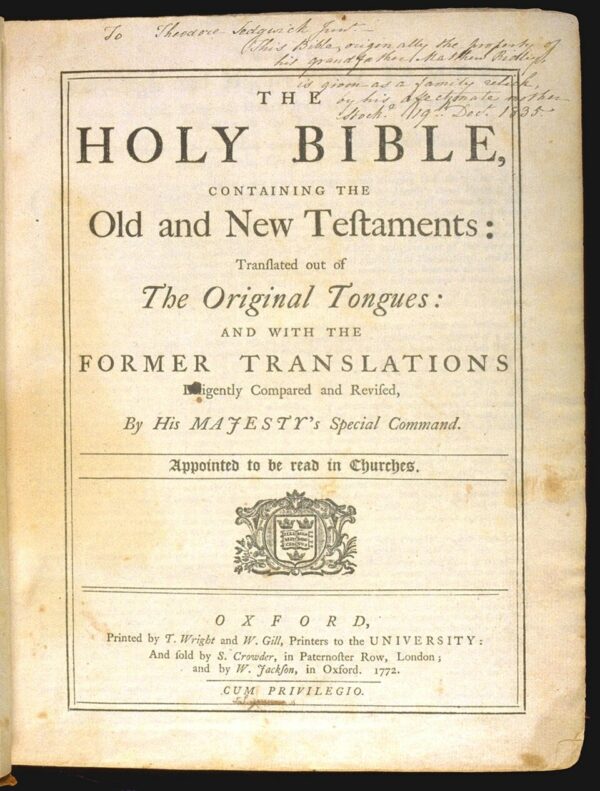
On May 2, 1611, the first edition of what would come to be known as the King James Version emerged from the presses of Robert Barker in London, a publication event that, while at the time one among many state-directed printing enterprises, would gradually assume a defining place in the religious, linguistic, and political development of the English-speaking world. The appearance of this text was not merely the production of a new Bible. It was the culmination of a decades-long struggle over authority, interpretation, and the proper relationship between crown, church, and scripture.
The origins of the translation lie in the early years of the reign of James I of England, whose accession to the English throne in 1603 brought with it both opportunity and tension. England’s religious landscape remained unsettled after the Elizabethan settlement. Competing factions—most notably the established Church hierarchy and reform-minded Puritans—disagreed not only over doctrine and ceremony, but over the very texts that undergirded religious life. Existing English translations, including the Geneva Bible and the Bishops’ Bible, carried with them distinct theological and political valences. The Geneva Bible, widely read among the laity, included marginal notes that often reflected a more radical Protestant outlook, at times implicitly challenging monarchical authority. For a king deeply invested in the consolidation of both religious and political order, this presented a problem.
It was in this context that the Hampton Court Conference of 1604 produced the proposal for a new translation. The project, once approved by James, was carefully structured. Rather than relying on a single translator or a narrow committee, the work was distributed among multiple companies of scholars, each assigned specific portions of the text. These translators were drawn from the universities and the clergy, men trained in Hebrew, Greek, and Latin, and instructed to produce a text that would be both faithful to the original languages and suitable for public reading in churches. The method was deliberate, iterative, and institutional, reflecting an effort to produce not simply accuracy, but consensus.
The resulting translation bears the marks of this process. Stylistically, it is characterized by a balance between formal dignity and linguistic clarity. The translators drew on earlier English versions, preserving familiar phrasing where possible, while refining the text through comparison with original manuscripts. The language they produced was neither archaic for its own sake nor colloquial in a fleeting sense. Instead, it achieved a kind of elevated plainness, a register capable of conveying theological complexity while remaining intelligible to a broad audience. Over time, this stylistic equilibrium would prove decisive in the text’s endurance.
Yet the significance of the 1611 publication cannot be reduced to literary achievement alone. The King James Bible functioned as an instrument of unification. By authorizing a single translation for use in the churches of England, the crown sought to stabilize a fragmented religious environment. The absence of contentious marginal notes, particularly those found in the Geneva Bible, was not incidental. It reflected a conscious decision to limit interpretive guidance that might undermine ecclesiastical or royal authority. In this sense, the text was as much a political document as a religious one, embodying a vision of ordered Protestantism aligned with the structures of the English state.

The material form of the first edition also reveals the nature of early modern print culture. Produced in large folio format, the 1611 Bible was intended for use in churches rather than private households. Its typography, layout, and even its errors—most famously the so-called “He” and “She” variants in the Book of Ruth—testify to the realities of seventeenth-century printing, where standardization was still developing and corrections often occurred across print runs rather than before them. These features, far from diminishing the text’s authority, underscore the conditions under which authoritative texts were made.
Over the subsequent centuries, the King James Version would extend far beyond its original institutional purpose. It became embedded in the rhythms of English prose, shaping idiom, metaphor, and rhetorical form. Its phrases entered common usage, its cadences influenced writers and speakers across domains, and its authority persisted even as new translations emerged. What began as a state-sponsored effort to resolve specific ecclesiastical disputes evolved into a foundational text of a linguistic tradition.