On May 10, 1775, delegates from across the American colonies gathered in Philadelphia for the opening of the Second Continental Congress, a meeting that began as an emergency response to war and soon became the central political body of the American Revolution.
The Congress convened at the Pennsylvania State House, later known as Independence Hall, less than a month after the battles of Lexington and Concord. The fighting in Massachusetts had shattered the fragile hope that the colonies’ dispute with Britain could remain purely political. British troops had marched into the countryside to seize colonial military supplies. Militiamen had resisted. Shots had been fired. Men had died. By the time delegates arrived in Philadelphia, the question was no longer whether tensions were serious, but whether the colonies could act together before events overtook them.
The First Continental Congress, which had met the previous year, had petitioned King George III and organized economic pressure against Britain. The Second Congress faced a different problem. The colonies were now in a state of armed conflict, but they had no national government, no unified army, no common treasury, and no clear agreement on independence. Many delegates still hoped for reconciliation with Britain. Others believed that the empire had already crossed a line from constitutional dispute to military coercion.
That tension defined the Congress from the beginning. Its members were not yet ready to declare independence, but they were increasingly forced to behave like the government of an independent people. The delegates had to coordinate colonial resistance, manage relations among the colonies, communicate with foreign powers, and give political direction to the military struggle already underway around Boston.
Among those present were some of the central figures of the Revolution. John Hancock of Massachusetts would soon be chosen president of the Congress. John Adams and Samuel Adams arrived from Massachusetts with firsthand knowledge of the crisis. Benjamin Franklin, recently returned from London after years of trying to defend colonial interests there, brought both international experience and a deepening skepticism about reconciliation. George Washington, a Virginia planter and veteran of the French and Indian War, attended in military uniform, a visible sign that the conflict might require organized force rather than resolutions alone.
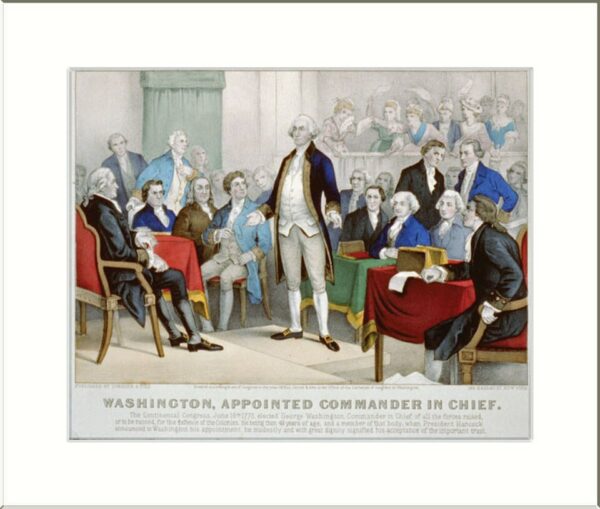
One of the Congress’s most consequential decisions came in June, when it created the Continental Army and appointed Washington as commander in chief. That choice was both military and political. New England had borne the first blows of the war, but the Revolution could not succeed as a regional uprising. By selecting Washington, a Virginian, Congress signaled that the cause belonged to more than Massachusetts. It was a continental cause, requiring unity across colonies with different economies, religions, political cultures, and local interests.

The Congress also tried to keep open the possibility of peace. In July 1775, it approved the Olive Branch Petition, a final appeal to King George III that professed loyalty while asking him to intervene against Parliament’s coercive policies. At the same time, Congress issued declarations explaining why Americans had taken up arms. This dual approach reflected the uncertainty of the moment. Many colonists still saw themselves as loyal subjects defending inherited English liberties, not revolutionaries seeking a new nation.
But events moved faster than moderation. The king refused to receive the Olive Branch Petition and declared the colonies in rebellion. British military action expanded. Colonial opinion hardened. Thomas Paine’s “Common Sense,” published in January 1776, gave popular force to arguments that had been gaining strength inside and outside Congress. By the summer of 1776, the body that had assembled to manage a crisis had become the institution that would declare American independence.