

On May 16, 1866, the United States Congress authorized a new five-cent coin made primarily of nickel, giving rise to one of the most familiar pieces of American currency. The coin was small, practical, and durable, but its creation reflected something larger than a simple change in pocket money. It marked a turning point in the nation’s recovery from the Civil War, when the federal government was still trying to restore confidence in money, commerce, and national institutions.
Before the nickel, Americans already had a five-cent coin. It was the half dime, a small silver coin that had circulated since the early years of the republic. But by the 1860s, silver coins had largely disappeared from everyday circulation. During the Civil War, as uncertainty spread and the value of paper money fluctuated, Americans began hoarding gold and silver. Coins vanished from the marketplace, leaving merchants and customers struggling to make small transactions.
The shortage became so severe that people turned to substitutes. Businesses issued private tokens. The federal government printed fractional paper currency, including notes worth just a few cents. These small notes helped keep commerce moving, but they were unpopular, fragile, and easily damaged. A more durable coin was needed, especially for daily purchases in an economy trying to return to normal after the war.
The answer was the five-cent nickel. The Coinage Act signed into law in 1866 authorized a coin made of 75 percent copper and 25 percent nickel, the same basic composition that would become standard for the coin. Unlike the silver half dime, the new coin had no precious metal content. Its value came not from the metal itself, but from the authority of the federal government. That made it part of a broader postwar shift toward modern, government-backed money.
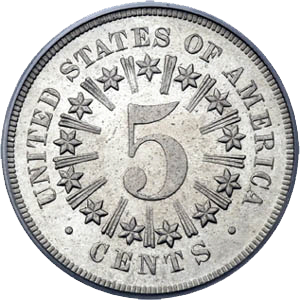
The first design was known as the Shield nickel. The front displayed a shield, symbolizing national unity and strength after the Civil War. The reverse originally showed the number 5 surrounded by stars and rays. But the rays were soon removed because they made the coin difficult to strike clearly. Even in its earliest form, the nickel was a coin of Reconstruction America: practical, nationalistic, and shaped by the pressures of war and recovery.
The nickel also owed its rise to industrial and political influence. Nickel mining interests, especially those connected to industrialist Joseph Wharton, promoted the metal as an ideal material for coinage. Nickel was harder than silver and copper, which made the coins more durable, though also more difficult for the Mint to produce. Its adoption helped create a market for the metal and demonstrated how postwar industrial power increasingly shaped federal policy.
For ordinary Americans, however, the nickel mattered because it worked. It was sturdier than paper fractional currency, easier to handle than tiny silver coins, and useful in everyday exchange. It could buy newspapers, streetcar rides, food items, and other small necessities. In an era before electronic payments, credit cards, or even widespread checking accounts, small coins were essential to the rhythm of daily life.

The nickel did not immediately replace the half dime. For a time, both coins existed, but the writing was on the wall. The half dime was discontinued in 1873, leaving the nickel as the nation’s standard five-cent coin. Over the decades, its design changed repeatedly, from the Shield nickel to the Liberty Head nickel, the Buffalo nickel, and eventually the Jefferson nickel introduced in 1938. But the basic idea established in 1866 endured.
The creation of the nickel was a small act of legislation with lasting consequences. It showed how the Civil War transformed even the most ordinary features of American life, including the coins people carried in their pockets. Congress was not merely authorizing a new piece of change. It was helping build a more unified national currency, one based on federal credibility rather than precious metal alone.