On May 19, 1962, President John F. Kennedy arrived at Madison Square Garden for what was officially billed as a birthday celebration. Kennedy would not turn 45 until May 29, but the Democratic Party turned the occasion into something larger than a private tribute. It was a political gala, a celebrity spectacle, and one of the most memorable moments in the history of modern presidential image-making.
The event, formally called a “Birthday Salute to President Kennedy,” drew thousands of supporters to the New York arena and brought together some of the most famous entertainers in the country. It was also a fundraiser for the Democratic Party, reflecting the increasingly close relationship between politics, television, money, and celebrity culture in the early 1960s.
Kennedy was already a president made for the television age. Young, polished, witty, and comfortable before cameras, he represented a break from the older political style that had dominated Washington. His 1960 campaign had shown the power of television, particularly during his debates with Richard Nixon. By 1962, the Kennedy White House had become a cultural symbol as much as a political institution. The president and first lady Jacqueline Kennedy projected youth, sophistication, and glamour at a moment when America was trying to define itself during the Cold War.
That atmosphere shaped the Madison Square Garden event. The evening included appearances by major stars, including Ella Fitzgerald, Maria Callas, Peggy Lee, Henry Fonda, Jimmy Durante, Bobby Darin, and others. The entertainment world had gathered not merely to honor a president, but to participate in the mythology surrounding him. The event suggested that Kennedy was not simply the nation’s chief executive. He was the center of an American court, surrounded by artists, actors, writers, and performers who helped give his administration its cultural shine.
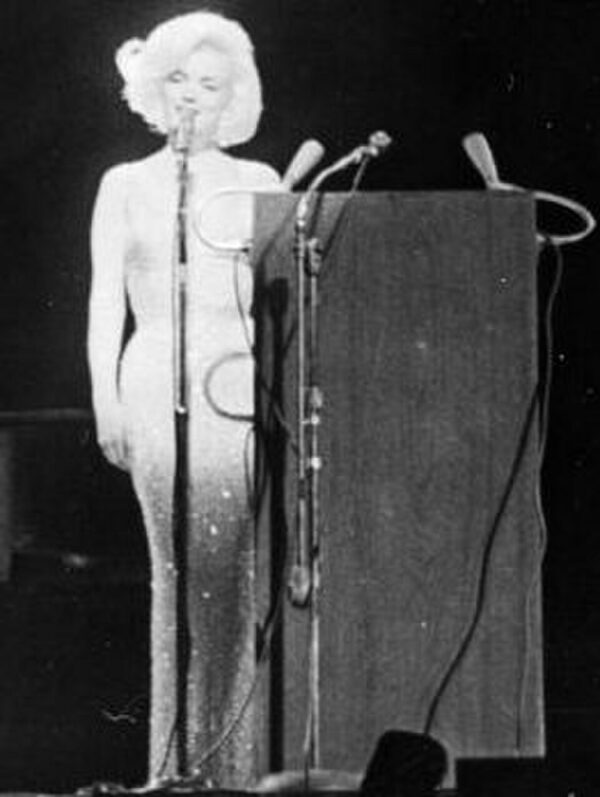
But the moment that entered history came near the end of the program, when Marilyn Monroe stepped onto the stage.
Monroe was already one of the most famous women in the world. Her film career had made her an international symbol of beauty and vulnerability, and her public persona combined glamour with a sense of fragility that fascinated audiences. She arrived late, wearing a form-fitting, flesh-colored gown covered in rhinestones, a dress so tight that it was said to have been sewn onto her. Under the arena lights, the effect was theatrical, daring, and unforgettable.
Then she sang.
Her breathy rendition of “Happy Birthday” to Kennedy lasted only a brief time, but it transformed the evening. It was intimate, theatrical, and charged with a kind of public flirtation that startled even an audience accustomed to celebrity performance. Monroe’s delivery was unlike a standard birthday song. It was slow, sultry, and carefully staged, turning a familiar tune into a national memory.
Kennedy followed with a joke that captured the tension of the moment. “I can now retire from politics after having had ‘Happy Birthday’ sung to me in such a sweet, wholesome way,” he said.
The line drew laughter, but the performance would take on a deeper significance in retrospect. Rumors about Kennedy’s private life had already circulated quietly, and Monroe’s appearance later became entangled in speculation about the president, his brother Robert Kennedy, and Monroe herself. Much of that speculation remains contested, exaggerated, or difficult to prove. What is certain is that the performance became inseparable from the mystique surrounding all three figures.

The timing made it even more haunting. Less than three months later, on Aug. 5, 1962, Monroe was found dead at her Los Angeles home at age 36. Kennedy would be assassinated in Dallas on Nov. 22, 1963. The Madison Square Garden salute, once a glittering political celebration, became part of a larger story of glamour, power, tragedy, and the fragility of the Kennedy era.
The event also marked a turning point in American political culture. It showed how celebrity could be used to humanize, elevate, and market a president. It blurred the line between politics and entertainment in ways that would become increasingly familiar in later decades. But in 1962, the scene still felt new: a president at the center of a star-studded gala, a Hollywood icon singing to him before a roaring crowd, and the whole country watching the boundaries of public life shift.
Marilyn Monroe’s performance lasted only a moment. Yet more than six decades later, it remains one of the defining images of the Kennedy presidency.