On May 26, 1940, one of the most dramatic operations of World War II began on the beaches and harbor of Dunkirk, France, as Allied forces, trapped by the German advance in northern France, launched a desperate evacuation across the English Channel.
The operation, known as Operation Dynamo, would become one of the defining episodes of the war. It began at a moment when Britain and France faced catastrophe. German forces had broken through the Allied lines, swept across the Low Countries and northern France, and driven the British Expeditionary Force, along with large numbers of French and Belgian troops, into an ever-tightening pocket near the Channel coast.
At the same time, the Battle of Dunkirk began in earnest. While evacuation ships gathered offshore and in English ports, Allied defenders fought to hold back the German offensive long enough for troops to escape. It was not simply a rescue operation. It was also a brutal defensive battle, fought under artillery fire, aerial bombardment, and the constant threat that German armor would overrun the perimeter before the evacuation could succeed.
The crisis had developed with stunning speed. Germany launched its western offensive on May 10, 1940, attacking through Belgium, the Netherlands, Luxembourg, and France. Allied commanders expected the main German thrust to come through Belgium, as it had in World War I. Instead, the Germans sent armored divisions through the Ardennes, a forested region many Allied planners had considered difficult terrain for tanks. Once through, German forces crossed the Meuse River and raced toward the Channel, cutting off Allied armies in the north from the rest of France.
By late May, the British Expeditionary Force and its allies were in grave danger. The German advance had shattered Allied coordination, and the collapse of Belgium’s army added to the pressure. Dunkirk became the last major escape route. If the troops trapped there were captured or destroyed, Britain would lose the core of its professional army at the very moment it might soon have to defend its own island from invasion.
Operation Dynamo was directed from a command center beneath Dover Castle by Vice Adm. Bertram Ramsay. The goal at first was modest. British officials feared that only a fraction of the stranded army could be saved. The situation at Dunkirk appeared almost hopeless: the port was under attack, the beaches were exposed, and large ships could not easily approach the shallow waters near the shore.
Yet the evacuation quickly expanded into a national effort. Royal Navy destroyers, merchant vessels, ferries, fishing boats, lifeboats, pleasure craft, and other small civilian vessels crossed the Channel to help carry soldiers home. These “little ships” later became central to the memory of Dunkirk, symbolizing civilian courage and national resolve. Their role was real, though the Royal Navy carried the bulk of evacuated troops. Together, the naval and civilian effort transformed what had looked like a military disaster into a remarkable rescue.
The fighting around Dunkirk made that rescue possible. British and French troops held defensive lines against repeated German attacks, buying time at enormous cost. French forces played a crucial role, particularly in protecting the evacuation perimeter while many British units embarked. Their sacrifice is sometimes overshadowed in popular memory, but without the defenders on the ground, the evacuation could not have continued.
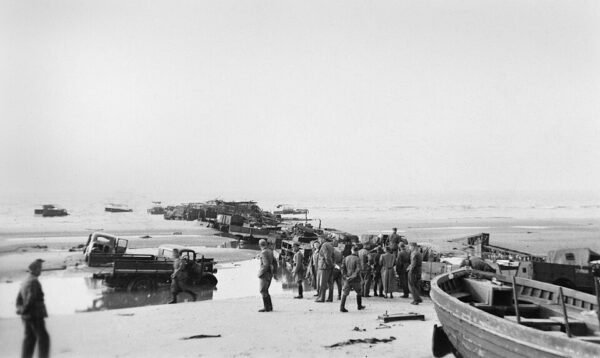
The Luftwaffe also attacked the beaches and ships, creating scenes of terror and confusion. Soldiers waited in long lines along the sand, exposed to bombing and strafing while hoping for a place aboard a vessel. Others waded into the water to reach boats. Equipment was abandoned in vast quantities. Britain saved men, but it left behind guns, vehicles, ammunition, and supplies that would be difficult to replace.

When Operation Dynamo ended on June 4, more than 338,000 Allied soldiers had been evacuated, including roughly 198,000 British troops and about 140,000 French and other Allied troops. The rescue exceeded even the most optimistic expectations. It preserved Britain’s ability to continue the war and gave the country a powerful story of endurance at a moment of national peril.
Still, Dunkirk was not a victory in the ordinary military sense. France remained on the brink of defeat, and Germany had won a stunning campaign on the continent. Prime Minister Winston Churchill understood the danger of romanticizing the evacuation. In his famous June 4 speech, he warned that “wars are not won by evacuations.”
But Dunkirk mattered because it prevented disaster from becoming total collapse. On May 26, 1940, the Allies began a retreat that became a rescue, and a rescue that became a symbol. Along the beaches of northern France, under fire and against the clock, Britain and its allies preserved the army that would fight on.