By the final day of May 1864, the American Civil War had entered a new and increasingly brutal phase. For nearly four weeks, Lt. Gen. Ulysses S. Grant had driven the Union Army of the Potomac southward through Virginia, refusing to retreat after battles that would have sent earlier Federal commanders back toward Washington. Grant had not destroyed Gen. Robert E. Lee’s Army of Northern Virginia. But he had forced Lee to fight continuously, surrendering ground even when the Confederates retained the tactical advantage.
On May 31, the two armies collided again at Cold Harbor, a rural crossroads roughly 10 miles northeast of Richmond. The engagement that began that day would culminate in one of the war’s most infamous assaults—and help transform the conflict in Virginia from a war of battlefield maneuver into a grinding struggle of trenches, fortifications, and attrition.
The Battle of Cold Harbor emerged from the relentless logic of Grant’s Overland Campaign. After the bloody stalemate in the Wilderness and nearly two weeks of fighting at Spotsylvania Court House, Grant maneuvered south toward the North Anna River, hoping to draw Lee into the open. Lee repeatedly anticipated the movement, placing his smaller army between Grant and Richmond. After inconclusive fighting along Totopotomoy Creek from May 28 to May 30, both commanders turned their attention toward Cold Harbor, where a network of roads offered access to the Confederate capital and to Union supply lines.
Grant ordered Maj. Gen. Philip Sheridan’s cavalry to seize the crossroads at Old Cold Harbor. Sheridan’s troopers arrived on May 31 and encountered Confederate cavalry commanded by Maj. Gen. Fitzhugh Lee, Robert E. Lee’s nephew. The fighting intensified when Confederate infantry from Maj. Gen. Robert Hoke’s division joined the contest. After a sharp engagement, Sheridan’s men drove the Confederates beyond the intersection and secured the position.
The crossroads itself was unremarkable. The strategic implications were not. Grant believed he could extend his left flank, protect his access to the James River, and place his army between Lee and Richmond. Lee understood the same danger. The Confederate commander began shifting troops toward Cold Harbor, establishing a defensive line that would grow stronger with each passing hour.
The initial Union success on May 31 therefore created a fleeting opportunity. Sheridan’s cavalry had captured the intersection, but cavalrymen alone could not hold the position indefinitely against Confederate infantry. Early on June 1, Sheridan’s troopers, aided by repeating carbines and shallow entrenchments, repelled another Confederate attack. Union infantry began arriving later that day, and elements of the Sixth and Eighteenth Corps attacked Lee’s developing line with limited success.
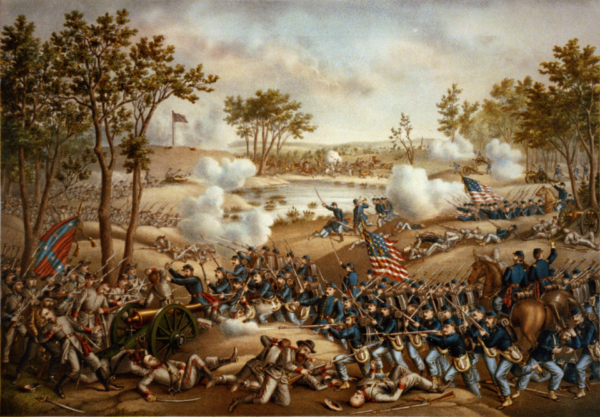
The delays that followed proved decisive. By June 2, Lee’s men had transformed the uneven and heavily wooded terrain into an interlocking network of trenches with overlapping fields of fire. Reinforcements strengthened the Confederate right. When the Union assault finally began before dawn on June 3, Grant’s soldiers advanced into a position designed to destroy them. Thousands were killed or wounded in less than an hour.

Cold Harbor became a Confederate victory and one of the darkest episodes of Grant’s military career. The National Park Service estimates that the larger battle, fought from May 31 to June 12, produced approximately 18,000 casualties: 13,000 Union and 5,000 Confederate. Grant later acknowledged that the final assault was the one attack he wished he had never ordered.
Yet Cold Harbor did not end the campaign. Grant again moved south, crossed the James River, and threatened Petersburg, the rail hub supplying Richmond and Lee’s army. Lee had won his last major battlefield victory. But Grant retained the initiative, and the war in Virginia entered its final, exhausting stage.