On January 12, 1962, the Vietnam War crossed a quiet but decisive threshold. In a rubber plantation northwest of Saigon, American helicopters ferried South Vietnamese troops into combat against communist guerrillas, marking Operation Chopper—the first American combat mission and first U.S.-backed helicopter assault of the war. Though modest in scale, the operation symbolized the United States’ transition from distant adviser to active battlefield participant, foreshadowing a conflict that would soon dominate American politics, strategy, and national consciousness.
At the time, Washington still described its role in Vietnam as limited. Fewer than 4,000 U.S. military advisers were stationed in South Vietnam, officially tasked with training and support rather than combat. Yet the insurgency led by the Viet Cong was intensifying, and the South Vietnamese Army (ARVN) struggled to counter a mobile enemy that relied on surprise, concealment, and local support. American planners believed that new technology—especially helicopters—could neutralize these advantages.
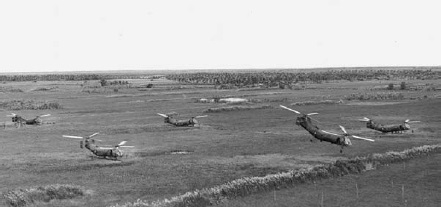
Operation Chopper was conceived as a test of that belief. The mission targeted a Viet Cong stronghold near the village of Duc Hoa in Long An Province. U.S. Army CH-21 “Flying Banana” helicopters, flown by American pilots, transported roughly 1,000 ARVN troops into the area. While South Vietnamese soldiers conducted the ground assault, U.S. aircrews flew directly into hostile territory, exposing themselves to enemy fire and engaging in what could no longer credibly be called a non-combat role.
The helicopters were central to the operation’s significance. Military theorists saw vertical envelopment—the rapid insertion of troops by air—as a revolutionary answer to guerrilla warfare. Helicopters could bypass jungles, rivers, and roads vulnerable to ambush, allowing government forces to strike quickly and withdraw before the enemy could melt away. In theory, speed and mobility would compensate for the ARVN’s weaknesses in morale, leadership, and intelligence.
The reality was more ambiguous. Although Operation Chopper succeeded in landing troops and demonstrated the feasibility of helicopter assaults, it failed to deliver a decisive blow to the Viet Cong. Many guerrillas slipped away before the cordon closed, aided by local villagers and superior knowledge of the terrain. The operation exposed early problems that would recur throughout the war: unreliable intelligence, coordination difficulties between air and ground forces, and the enemy’s ability to avoid set-piece battles.

Nevertheless, American officials publicly framed the mission as a success. Photographs of helicopters lifting off with South Vietnamese troops—sleek machines symbolizing modern warfare—were circulated as evidence that the tide could be turned. For the administration of President John F. Kennedy, Operation Chopper reinforced the conviction that limited, technologically sophisticated involvement could stabilize South Vietnam without committing large numbers of U.S. ground troops.
That conviction would prove dangerously optimistic. Far from remaining limited, helicopter operations became a defining feature of the war. What began as advisory support soon expanded into routine American combat missions, search-and-destroy operations, and large-scale air mobility campaigns. The helicopters of Operation Chopper were the ancestors of the ubiquitous Hueys that would later ferry U.S. soldiers into some of the war’s fiercest battles.