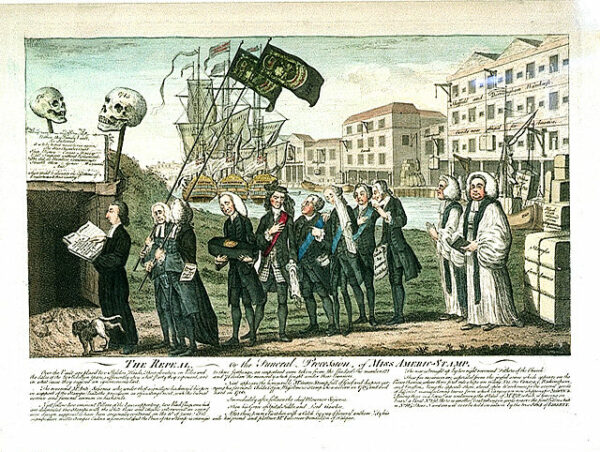
On March 18, 1766, the British Parliament retreated—reluctantly, strategically—from one of the most consequential miscalculations of its imperial administration: the Stamp Act. Barely a year after its passage, the law had ignited a colonial resistance that revealed, with startling clarity, the limits of parliamentary authority in America. Its repeal marked not a resolution, but a recalibration—an attempt to preserve imperial control while conceding, at least temporarily, to colonial outrage.
The Stamp Act of 1765 had been conceived in the aftermath of the Seven Years’ War, a conflict that left Britain victorious but financially strained. Parliament, facing mounting debt and the ongoing cost of defending its North American territories, sought new revenue streams. The colonies, long accustomed to a degree of fiscal autonomy, presented an obvious target. The Act imposed a direct tax on a wide array of printed materials—legal documents, newspapers, pamphlets, even playing cards—requiring that they bear an official stamp purchased from British authorities.
From London’s perspective, the measure was both reasonable and restrained. From the colonies’ vantage point, it was something else entirely: a constitutional provocation. For the first time, Parliament had levied an internal tax directly on colonial subjects without the consent of their elected assemblies. The response was swift and, in many places, explosive.
Colonial opposition coalesced around a principle that would become foundational to the American Revolution: no taxation without representation. But this was not merely a slogan—it was a constitutional argument. Colonists contended that, as Englishmen, they could not be taxed without the consent of their own representatives. Parliament, in which they had no direct voice, lacked that authority. British officials countered with the doctrine of “virtual representation,” insisting that Parliament represented the interests of all subjects of the empire, whether they voted for its members or not. The argument satisfied few in America.
Resistance took organized and often confrontational forms. The Stamp Act Congress convened in New York in October 1765, bringing together delegates from nine colonies to coordinate a unified response. Their petitions to the Crown and Parliament were measured but firm. On the streets, however, resistance was less restrained. Groups like the Sons of Liberty mobilized crowds, intimidated stamp distributors, and in some cases destroyed property. Effigies were burned, offices ransacked, and tax officials forced to resign. In many colonies, the Act became unenforceable not because it was repealed, but because no one would carry it out.
Equally significant were the economic pressures exerted by colonial merchants. Non-importation agreements—boycotts of British goods—began to bite into the profits of British manufacturers and merchants, particularly in London, Bristol, and Liverpool. These commercial interests, alarmed by declining exports and mounting inventories, became unlikely allies of the colonial cause. They petitioned Parliament, arguing that the tax was not only politically destabilizing but economically self-defeating.
Inside Parliament, the debate over repeal revealed deep divisions within the British political class. Figures such as William Pitt the Elder argued forcefully that Parliament had no right to tax the colonies internally, distinguishing between regulation of trade and revenue-raising measures. Others, including supporters of Prime Minister George Grenville—the architect of the Stamp Act—insisted that parliamentary sovereignty was indivisible. To concede on taxation, they warned, would invite broader challenges to imperial authority.

The repeal, when it came, was thus carefully constructed. Parliament withdrew the Stamp Act, but simultaneously passed the Declaratory Act, asserting its authority to make laws binding the colonies “in all cases whatsoever.” The message was unmistakable: the tax was gone, but the principle behind it remained intact.
In the colonies, news of the repeal was greeted with celebration. Bells rang, bonfires were lit, and merchants resumed trade. For many, it appeared a vindication of coordinated resistance—proof that imperial policy could be shaped, even reversed, by colonial action. Yet beneath the celebrations lay an unresolved tension. Parliament had yielded on one measure but reaffirmed its ultimate authority.