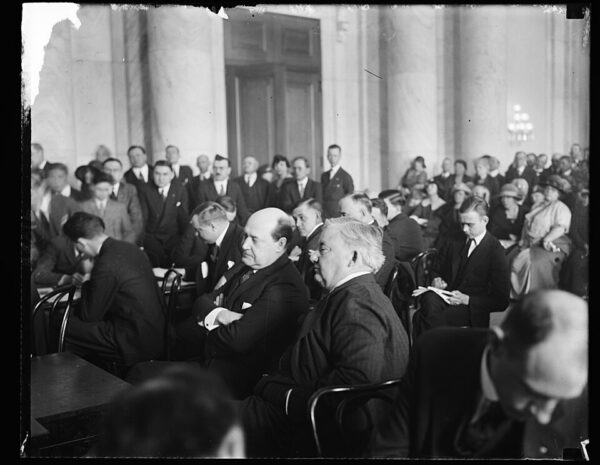
On April 15, 1922, a relatively obscure Senate resolution introduced by John B. Kendrick set in motion one of the most consequential corruption investigations in American history. What began as a narrowly framed inquiry into a quiet land transaction would soon unravel into the Teapot Dome scandal—a case that exposed the inner workings of executive power, private influence, and the fragility of public trust in government.
Kendrick, a Democrat representing Wyoming, had grown concerned about reports that federal oil reserves—specifically those located at Teapot Dome in his home state—had been leased under unusual and opaque circumstances. His resolution called for the Senate to investigate what appeared, at first glance, to be a routine administrative decision. But the lack of transparency surrounding the leases raised suspicions that something more consequential was at play.
At the center of the controversy was Albert B. Fall, who had been appointed Secretary of the Interior by President Warren G. Harding in 1921. Fall, a former senator himself, had successfully persuaded Harding to transfer control of key naval petroleum reserves from the Navy Department to the Interior Department. These reserves, including Teapot Dome in Wyoming and Elk Hills in California, were intended as strategic assets for national defense, particularly for fueling the Navy in times of emergency.
Once under his control, Fall moved quickly to lease the reserves to private oil companies—most notably to Harry F. Sinclair and Edward L. Doheny—without competitive bidding. The agreements were justified publicly as necessary for efficient development, but they bypassed standard procedures designed to ensure fairness and accountability.
Kendrick’s resolution did not initially allege wrongdoing. It simply sought clarity. Yet as the Senate Committee on Public Lands began its inquiry—later led with increasing intensity by Montana Senator Thomas J. Walsh—a far more troubling picture emerged. Investigators discovered that Fall had received substantial “loans” from the very oilmen who had benefited from the leases. Doheny, for instance, had provided Fall with $100,000 in cash, delivered in a suitcase—a transaction that would become emblematic of the scandal’s brazenness.
Fall initially denied any impropriety, framing the payments as private financial arrangements unrelated to his official duties. But the timing and scale of the transactions, combined with the secrecy of the leases, proved difficult to reconcile with that defense. As evidence accumulated, the Senate inquiry transformed from a procedural review into a full-scale corruption investigation.
The scandal struck at the heart of the Harding administration, which had already been dogged by allegations of cronyism and mismanagement. Although Harding himself was never directly implicated in the scheme—and died in office in 1923 before the investigation reached its peak—the revelations contributed to a broader perception of an administration compromised by insider dealing and weak oversight.

In 1929, after years of legal battles, Fall became the first former cabinet member in U.S. history to be convicted of a felony for crimes committed while in office. He was found guilty of accepting bribes and was sentenced to prison, marking a rare instance of high-level accountability in an era often defined by its tolerance for political patronage.
The Teapot Dome scandal had lasting institutional consequences. It prompted reforms aimed at increasing transparency in government contracting and reinforced the role of congressional oversight as a check on executive authority. It also reshaped public expectations, establishing corruption at the highest levels of government as not merely a political issue, but a matter of legal and ethical consequence.