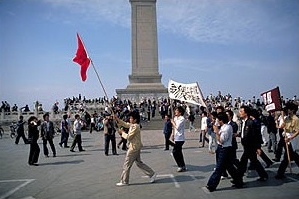
On April 27, 1989, tens of thousands of students poured into the streets of Beijing in one of the most pivotal early moments of the protests that would come to define the spring of dissent in the People’s Republic of China. The demonstrations, organized largely by university students, were a direct response to the April 26 editorial published in the official newspaper People’s Daily—an editorial that had sharply condemned the burgeoning student movement as “turmoil” threatening the authority of the state.
The government’s characterization marked a turning point. What had begun as mourning gatherings following the death of reform-minded leader Hu Yaobang earlier that month had evolved into a broader expression of frustration with corruption, inflation, and the slow pace of political reform. The April 26 editorial reframed these activities as illegitimate, effectively warning that continued protests could invite severe consequences. For many students, the language was not only inaccurate but incendiary—an attempt to delegitimize their demands and justify a crackdown.
In response, student leaders from universities across Beijing coordinated a large-scale march for the following day. Beginning in the morning hours, students from institutions such as Peking University and Tsinghua University assembled on campuses before moving toward the city center. Despite government warnings and efforts to restrict movement, columns of students advanced along major thoroughfares, chanting slogans and carrying banners calling for democracy, press freedom, and an end to official corruption.
What distinguished the April 27 demonstrations from earlier gatherings was not only their size—estimates ranged into the tens of thousands—but their interaction with the broader public. As students moved through the streets, residents of Beijing emerged in large numbers to observe and, increasingly, to participate. Workers, office employees, and even some government personnel lined the routes, applauding the marchers, offering water, and in some cases joining the procession. The demonstrations thus began to transcend their origins as student protests, taking on the character of a wider civic movement.
Crucially, the authorities—while maintaining a visible presence—did not immediately resort to force. Police units monitored the marches, and at several intersections, there were tense moments as lines of officers attempted to block the students’ advance. Yet, in many instances, these confrontations ended without violence. Some accounts describe police allowing students to pass after brief standoffs, a decision that contributed to a sense of cautious optimism among participants.

By midday, large numbers of demonstrators had converged near Tiananmen Square, which would soon become the symbolic and geographic center of the movement. Speeches were delivered, petitions circulated, and calls intensified for dialogue with government leaders. The orderly nature of the march—combined with its scale—challenged the narrative advanced in the April 26 editorial. Rather than “turmoil,” participants emphasized discipline, patriotism, and a desire for constructive reform.
The events of April 27 also had a significant psychological effect. The willingness of ordinary citizens to support the students emboldened protest organizers and reinforced their belief that their cause resonated beyond university campuses. At the same time, the absence of an immediate crackdown suggested—perhaps misleadingly—that the government might tolerate, or even engage with, the movement.