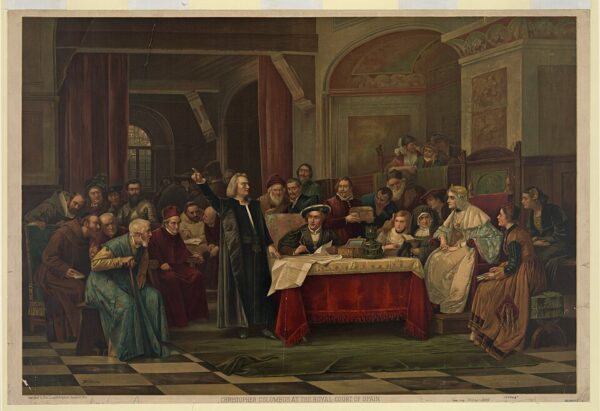
On May 1, 1486, Christopher Columbus stood before Isabella I of Castile and presented a proposal that, on its face, strained credibility. He argued that the wealth of Asia—the spices, silks, and trade networks that had long drawn European attention—could be reached not by navigating around Africa, as the Portuguese were attempting, but by sailing directly west across the Atlantic. It was a theory built on incomplete data, aggressive assumptions, and a willingness to disregard the prevailing estimates of distance. Yet it was also a theory calibrated to a specific political moment: a rising monarchy, newly consolidated, searching for ways to extend its reach.
Columbus was not introducing a new concept so much as forcing a decision. By the late fifteenth century, the sphericity of the earth was not in dispute among educated Europeans. The disagreement lay in scale. Columbus insisted the distance westward to Asia was manageable; most scholars concluded it was prohibitive. The difference was not marginal. It was the difference between a voyage that could be supplied and one that could not. Columbus resolved that gap not by refining his estimates, but by compressing the world to fit his argument.
The court he entered was not predisposed to speculative ventures. Isabella and her husband, Ferdinand II of Aragon, were in the final stages of consolidating control over the Iberian Peninsula. The Reconquista was nearing completion, and the monarchy’s resources—financial, military, and administrative—were directed inward. This was a government focused on territorial integration, not maritime experimentation. Columbus’s proposal, therefore, was not treated as an opportunity, but as a problem to be evaluated.
It was referred to a council. That detail matters. The Spanish crown did not dismiss the idea outright, but neither did it indulge it. Instead, it subjected the proposal to institutional review. Cosmographers examined the distances. Theologians considered the implications. Navigators assessed the practical limits of ships and supply. The conclusion was cautious and, in material terms, correct: Columbus had underestimated the scale of the voyage. The distance to Asia was far greater than he claimed, and the risks were correspondingly higher.
But the council did not end the discussion. The proposal remained in circulation, neither approved nor rejected. This was not indecision. It was optionality. The monarchy preserved the idea without committing to it, allowing it to be reconsidered as conditions changed. That is the critical function of the 1486 audience. It moved Columbus’s theory from abstraction into a queue of potential state actions.
Columbus, for his part, understood that technical arguments alone would not carry the day. He framed the expedition in strategic terms. A westward route would bypass existing trade intermediaries, many of whom operated under political constraints that limited Spanish access. It would provide a direct channel to high-value goods. It would also position Spain against Portugal, which was advancing methodically along the African coast and accumulating both knowledge and influence. The proposal, in this sense, was less about geography than about competition.

He added a religious dimension, not incidentally. The expansion of Christianity remained a central organizing principle of the Spanish monarchy. Columbus suggested that new routes would open pathways for conversion and extend the crown’s influence beyond Europe. This was not a separate argument from commerce or power. It was part of the same framework. In late fifteenth-century statecraft, these categories were mutually reinforcing.
The timing, however, was not yet aligned. The crown had not finished its primary project. Until that changed, Columbus’s proposal could not advance. What the 1486 meeting accomplished was to ensure that when the strategic environment shifted, the option would be available. When Granada fell in 1492, the constraints that had limited the monarchy’s flexibility began to loosen. Columbus returned with the same argument, now positioned within a different set of priorities.