On December 13, 1623, the small and precarious Plymouth Colony took a step whose significance far exceeded its population or power. That winter, the colony formally established trial by a jury of twelve men, marking the first known adoption of the English common-law jury system in what would become the American colonies. In doing so, the Pilgrims quietly transplanted one of England’s most enduring legal institutions into New World soil—where it would take deeper root than even its creators could have imagined.
The decision came at a moment of strain and uncertainty. Plymouth, founded just three years earlier by Separatists fleeing religious persecution, was still fighting for survival. Disease, hunger, internal discord, and tense relations with neighboring Native tribes had defined its earliest years. The colony had begun under the Mayflower Compact of 1620, a brief but revolutionary agreement that pledged collective self-government under God and the rule of law. Yet the Compact offered principles, not procedures. By 1623, the settlers faced a practical problem: how to resolve disputes fairly without descending into factionalism or arbitrary rule.
The answer they chose was deeply familiar. Trial by jury was not a novelty to the English mind. By the early seventeenth century, juries had become a central safeguard against tyranny, arbitrary punishment, and royal overreach. Rooted in Magna Carta and refined through centuries of common-law practice, the jury embodied the belief that judgment should rest not in the hands of distant authority, but among one’s peers. For the Plymouth colonists—many of whom had experienced religious courts and royal decrees as instruments of oppression—the jury was more than a legal mechanism. It was a moral guarantee.
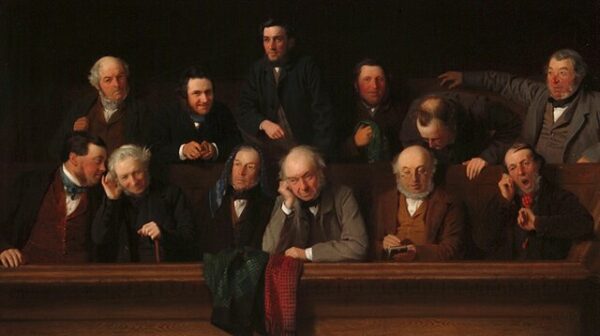
The Plymouth court established that twelve men, drawn from the community, would hear evidence, weigh testimony, and render verdicts in both civil and criminal matters. This was a deliberate rejection of centralized authority. Rather than empower magistrates alone to decide guilt or innocence, the colony placed judgment in the collective conscience of ordinary settlers. In a fragile society where everyone depended on everyone else, legitimacy mattered. A verdict reached by neighbors carried weight precisely because it reflected shared norms and communal responsibility.
This decision also reflected the colonists’ worldview. The Pilgrims believed that law was not merely an instrument of order, but a reflection of divine justice. While Plymouth’s legal system was infused with religious language and biblical reference, the jury served as a mediating institution between scripture and human judgment. It acknowledged human fallibility while trusting that a group, rather than an individual, was less likely to err—or abuse power.
Though small in scale, Plymouth’s jury system set a powerful precedent. Other colonies would follow. Massachusetts Bay, Connecticut, Virginia, and later Pennsylvania all incorporated jury trials into their legal frameworks. Over time, the jury became not just a legal right, but a symbol of colonial resistance to external control. When royal governors attempted to impose admiralty courts or bypass juries altogether, colonists protested—not because the jury was ancient, but because it had become theirs.

By the eighteenth century, trial by jury was inseparable from American identity. Colonial pamphlets denounced juryless courts as tools of despotism. The Declaration of Independence later condemned King George III “for depriving us in many cases, of the benefits of Trial by Jury.” The Sixth and Seventh Amendments would ultimately enshrine the right in the Constitution, elevating a practice born of necessity in Plymouth into a cornerstone of American liberty.
What began in a drafty meetinghouse in Plymouth would echo across centuries of courtrooms, becoming one of the most enduring legacies of early American self-government.