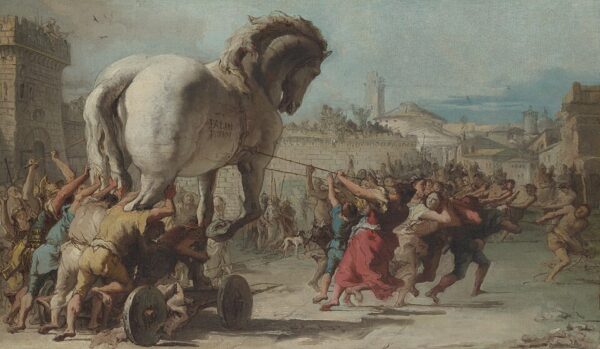
April 24, 1183 BC—at least according to the calculations of Eratosthenes—marks the traditional date of the fall of Troy, the climactic end of the legendary Trojan War. Though the conflict itself belongs as much to myth as to history, the date has endured for centuries as a symbolic endpoint to one of the ancient world’s most enduring stories: a war of heroes, gods, and a city brought low by cunning rather than force.
The story of Troy’s fall comes down to us primarily through epic poetry, especially The Iliad and later works like The Aeneid. While The Iliad, attributed to Homer, recounts only a brief period near the end of the war—focusing on the rage of Achilles and the death of Hector—the broader narrative of the war’s conclusion was filled in by later Greek and Roman traditions. Chief among these is the tale of the Trojan Horse, a stratagem by which Greek forces gained entry into the city after a decade-long siege.
According to legend, the war began when Paris, prince of Troy, abducted—or eloped with—Helen, the wife of Menelaus, king of Sparta. In response, a coalition of Greek kings assembled an expeditionary force to retrieve her, led by Agamemnon of Mycenae. What followed was a protracted conflict marked by stalemate, punctuated by episodes of individual heroism: Achilles, the greatest of the Greek warriors; Hector, Troy’s noble defender; and Odysseus, whose cunning would ultimately decide the war’s outcome.
After years of failed assaults, the Greeks turned to deception. They constructed a massive wooden horse, ostensibly as an offering to the gods, and left it outside the gates of Troy while feigning retreat. The Trojans, interpreting the gesture as a sign of victory, brought the horse into the city. Under cover of night, Greek soldiers hidden within emerged, opened the gates to their returning army, and unleashed destruction. Troy was sacked, its people slaughtered or enslaved, and its legendary walls reduced to ruin.
The date of April 24, 1183 BC, originates not from contemporary records—none survive—but from later chronographers attempting to impose order on the distant past. Eratosthenes, a polymath who served as chief librarian at the Library of Alexandria in the third century BC, sought to systematize Greek history by assigning dates to mythological events. His chronology placed the fall of Troy in 1183 BC, a calculation that would be widely adopted by later historians.

Modern archaeology has complicated the picture. Excavations at the site of ancient Troy, identified with the mound of Hisarlik in modern-day Turkey, have revealed multiple layers of settlement, several of which show evidence of destruction. Scholars have debated which, if any, might correspond to a historical Trojan War. One candidate, known as Troy VIIa, appears to have been violently destroyed around the late 13th century BC—roughly consistent with Eratosthenes’ timeline, though far from definitive proof.
Even so, the enduring power of the Trojan War lies less in its historical certainty than in its narrative resonance. The story has been retold for millennia, shaping literature, art, and cultural imagination across civilizations. From Greek tragedy to Roman epic, from Renaissance painting to modern film, the fall of Troy remains a touchstone for themes of hubris, fate, and the fragile boundary between victory and catastrophe.