
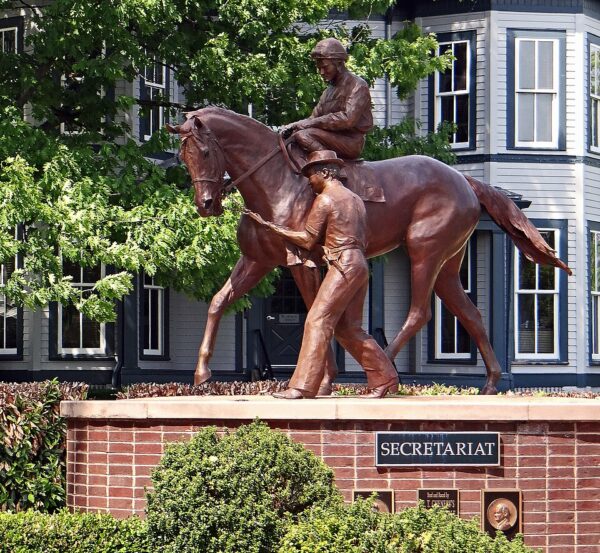
On May 5, 1973, Secretariat did not simply win the Kentucky Derby; he reset the event’s outer boundary. At Churchill Downs, the chestnut colt covered a mile and a quarter in 1:59.4, breaking a barrier that had held for nearly a century. The number has endured. More than fifty years on, it remains less a record than a constraint, a limit every subsequent Derby winner has approached but never crossed.
The structure of the race explains why. Under Ron Turcotte, Secretariat did not expend himself early. He broke cleanly, then settled into a measured stalking position behind a quick pace set by Sham and the front-runners. What followed was not a conventional late surge but a controlled, sequential acceleration. Each quarter-mile was faster than the last. In a discipline governed by fatigue, he inverted the expected pattern. Where others decelerate, he compounded speed.
By the far turn, the race shifted from contest to demonstration. Turcotte angled him outside, and the response was immediate and decisive. Secretariat lengthened his stride, overtook Sham, and separated from the field entering the stretch. The official margin, two and a half lengths, understated the dominance; Turcotte eased him late once the outcome was secure. The clock did not. It fixed the performance at 1:59.4, converting a fluid athletic act into a permanent benchmark.
The Derby was not an isolated peak but the opening movement of a larger campaign. Secretariat would go on to win the Preakness Stakes and then the Belmont Stakes, completing the Triple Crown of Thoroughbred Racing with a 31-length margin in New York that remains equally implausible by modern standards. Yet the Derby provided the first clear signal. It established that this was not simply a superior horse operating at the high end of the existing range, but an outlier redefining that range itself.
The broader context sharpened the effect. By the early 1970s, American horse racing remained prominent but increasingly competed with a diversifying entertainment landscape. Its stars were rarely national figures beyond the sport. Secretariat broke that pattern. Owned by Penny Chenery and trained by Lucien Laurin, he combined pedigree with a visible physical distinctiveness that translated across audiences. His stride, later measured at more than 24 feet, became both a technical datum and a popular fascination. Even stripped of analysis, he was legible at a glance.

Within racing circles, the Derby introduced a more technical puzzle. The negative splits, each quarter faster than the last, implied not only conditioning but an unusual physiological capacity. Later examinations of Secretariat’s heart would reinforce that interpretation, but the underlying point was already evident in the tape from Churchill Downs. The performance expanded the conceptual model of how a mile-and-a-quarter race could be run. It suggested that the ceiling was higher than previously assumed.
Subsequent decades have produced champions of genuine quality, including Triple Crown winners, and some have arrived at the Derby with comparable expectations and delivering performances of real distinction. None have exceeded the time set in 1973.