
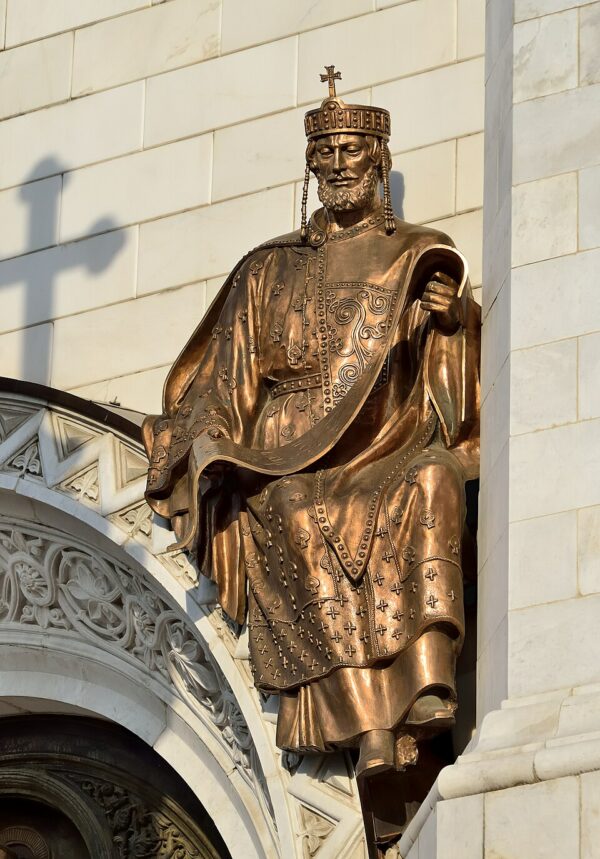
On May 11, 330, Constantine the Great marked one of the most consequential acts of urban and imperial reorientation in world history: the dedication of the rebuilt city of Byzantium as New Rome. The city would soon be known as Constantinople, and for more than a thousand years it would stand as the eastern anchor of Roman power, Christian civilization, and imperial continuity.
The old Byzantium was not an obvious rival to Rome in age, legend, or symbolic authority. Founded by Greek colonists from Megara in the seventh century B.C., it occupied a narrow, defensible site on the European side of the Bosporus, where Europe and Asia nearly touched. Its value lay less in its grandeur than in its geography. Whoever controlled Byzantium could watch the movement between the Black Sea and the Mediterranean, command routes between the Balkans and Asia Minor, and sit astride the commercial and military arteries of the eastern Mediterranean.
Constantine understood that geography better than most rulers. By the early fourth century, Rome remained the empire’s ceremonial heart, but it was no longer the practical center of imperial government. The Roman Empire had become too vast, too militarized, and too dependent on its eastern provinces for one emperor to govern effectively from the banks of the Tiber. The Danube frontier, the Persian threat, and the wealth of the Greek-speaking East all pointed away from old Rome and toward a more strategic capital.
Constantine’s decision followed years of civil war and consolidation. After defeating Maxentius at the Battle of the Milvian Bridge in 312, and later defeating Licinius in 324, Constantine emerged as sole ruler of the Roman world. He had already transformed the empire through his support for Christianity, most notably by ending persecution and granting the church new status and protection. But his refounding of Byzantium gave that transformation a permanent political and architectural home.
The city he dedicated in 330 was not built from nothing. It was rebuilt, enlarged, fortified, and adorned. Constantine expanded its walls, laid out new avenues, sponsored forums, baths, palaces, churches, and monuments, and filled the city with art and statuary drawn from older centers of the empire. In doing so, he made clear that New Rome was not merely a regional headquarters. It was an imperial capital, consciously designed to inherit Rome’s authority while standing closer to the empire’s future.
The name “New Rome” carried immense meaning. It signaled continuity rather than rupture. Constantine was not abolishing Rome or founding a separate empire. He was relocating the center of gravity within the Roman world. The Senate, court ceremonial, public games, imperial architecture, and civic institutions all reflected the old capital’s model. Yet the new city also differed from Rome in important ways. It was more closely associated with Christianity, more securely positioned for eastern defense, and less burdened by the pagan aristocratic traditions that still shaped politics in the old capital.
This made Constantinople both Roman and new. Its identity was not a rejection of the past but a reorganization of it. The city stood at the meeting point of Latin imperial power, Greek language and culture, Christian theology, and eastern commerce. That fusion would define the civilization later called Byzantine, though its citizens continued to think of themselves as Romans. To them, Constantinople was not a substitute for Rome; it was Rome’s living continuation.

The consequences were enormous. When the western half of the Roman Empire weakened and eventually collapsed in the fifth century, Constantinople endured. Its walls resisted invaders for centuries. Its bureaucracy preserved Roman law. Its churches shaped Christian doctrine. Its scholars transmitted Greek learning. Its emperors, though ruling from the Bosporus rather than Italy, claimed the mantle of Caesar and Augustus.
The city became a hinge of history. From Constantinople, Justinian would later attempt to reconquer the western Mediterranean. Missionaries would carry Christianity into Slavic lands. The great theological controversies of the early church would be debated in its councils and court circles. Its wealth would attract merchants, pilgrims, armies, and crusaders. Even after its conquest by the Ottoman Turks in 1453, the city’s imperial geography remained decisive, helping make Istanbul one of the great capitals of the Islamic world.