
On November 10, 1202, the men of the Fourth Crusade stood aboard their ships and gazed up at the walls of Zara, a port on the Adriatic coast in what is now Croatia. Geoffrey de Villehardouin, a French knight who sailed with the expedition, remembered his companions wondering aloud how anyone could take so formidable a city without the help of God. The people behind those walls had good reason to believe God might take their side. They were Catholics, their king had taken the crusader’s vow, and the pope who had called the crusade had forbidden the men aboard those ships to attack them.
Four years earlier, Pope Innocent III had appealed to the rulers and nobles of Europe to recover Jerusalem, which had fallen to Saladin in 1187. The French barons who answered the call intended to strike first at Egypt, whose wealth and military power sustained Muslim rule in the Holy Land. That strategy required a fleet large enough to carry thousands of horses across the Mediterranean along with the knights who rode them, the foot soldiers who fought beside them, and enough food to keep them all in the field. In 1201, a delegation that included Villehardouin traveled to Venice to negotiate a price.
The Venetians agreed to transport and provision an army of 33,500 men for 85,000 marks of silver. By the following summer, the ships were ready. Only about a third of the expected army had come to Venice. Some crusaders had found passage at other ports, an understandable decision for a man paying his own way but a calamity for the barons who had promised to pay for everyone. Even after the leaders turned over their own gold and silver plate, the army still owed the Venetians some 34,000 marks.
Enrico Dandolo, the elderly doge of Venice, offered to give the crusaders more time to pay if they would first help his republic recover Zara. The city had cast off Venetian rule and placed itself under the protection of the king of Hungary. For Dandolo, the bargain offered a chance to regain a valuable port. For the barons, it meant that men who had sold property and left their families to fight for Jerusalem might yet fulfill their vows. They accepted, although some of their own men considered an attack on Zara a violation of the very vow they hoped to keep.
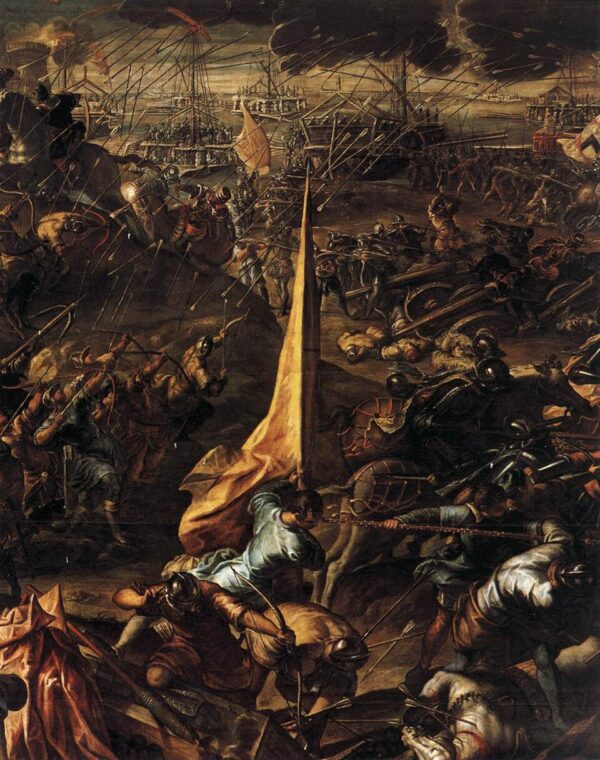
That division followed them ashore. After the fleet arrived on November 10, representatives of Zara offered to surrender the city to Dandolo in exchange for their lives. While the doge consulted the barons, opponents of the attack assured the delegation that the French would never help Venice take the city. The representatives withdrew their offer. Guy, the Cistercian abbot of Vaux, then stood before the crusade’s leaders and reminded them whom they proposed to fight. In Villehardouin’s account, he invoked the pope’s authority and told them that “those within it are Christians, and you are pilgrims.” Dandolo reminded the barons of their promise to him. They ordered the siege engines into position.

Zara surrendered on November 24. The victors plundered the city and divided its quarters between the French and the Venetians for the winter. Innocent excommunicated the attackers, though he later granted absolution to the non-Venetian crusaders after their representatives appealed to Rome. The barons’ defense was much the same one they had offered at Venice. Without the bargain, they said, the army would have broken up.
That winter in Zara, another delegation came before the barons. A Byzantine prince wanted their help recovering his father’s throne and offered enough silver to pay their debts, along with troops and provisions for the journey to the Holy Land. Once again, the leaders agreed. In April 1204, the men of the Fourth Crusade sacked Constantinople. Nearly two years after they had gathered at Venice, the barons had kept their army together long enough to conquer two Christian cities. Jerusalem was still beyond their reach.