

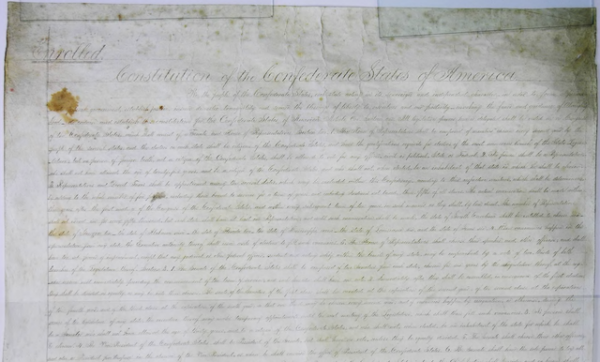
On March 11, 1861, in Montgomery, Alabama, delegates from the seceded Southern states adopted the Constitution of the Confederate States of America, a document that at once resembled and diverged from the United States Constitution it sought to replace. Written in the opening weeks of the Civil War, the Confederate constitution reflected the political anxieties, economic priorities, and ideological convictions of a slaveholding republic attempting to establish itself as a separate nation.
At first glance, the Confederate Constitution appeared strikingly familiar. Much of its language was copied directly from the United States Constitution of 1787. The framers—many of whom had served previously in Congress or state governments under the old Union—retained the familiar structure of three branches of government, a bicameral legislature, and a federal system balancing national and state authority. Even the preamble echoed its predecessor, though with a subtle but telling change: instead of “We the People of the United States,” it read, “We, the people of the Confederate States, each State acting in its sovereign and independent character.”
That phrase revealed one of the Confederacy’s central ideological commitments. Where the United States Constitution rested on the idea of a single national people, the Confederate version emphasized the sovereignty of the individual states. Secession itself had been justified on the grounds that the Union was a voluntary compact among states, and the new constitution sought to codify that theory. The Confederate government would exist, but always in careful tension with the autonomy of its member states.
Yet the most significant difference between the two constitutions lay in what the Confederate document made explicit. The United States Constitution of 1787 had contained compromises over slavery—such as the three-fifths clause and the fugitive slave provision—but it avoided using the word “slave” itself. The Confederate Constitution removed that ambiguity. It openly recognized and protected the institution of slavery, declaring that “no law denying or impairing the right of property in negro slaves shall be passed.”
This language reflected the political reality that slavery stood at the center of the secession movement. By 1861, Southern leaders no longer believed that the delicate constitutional compromises of the founding era were sufficient to protect their system. The Confederate Constitution therefore guaranteed the legality of slavery in all Confederate territories and prohibited the government from interfering with it. In effect, it nationalized the institution in a way the United States Constitution had never done.
Economic provisions also reflected Southern priorities. Confederate leaders blamed tariffs and federal economic policy for favoring Northern industry at the South’s expense. As a result, the Confederate Constitution sharply limited the government’s ability to impose protective tariffs or fund internal improvements. While the United States Constitution allowed Congress broad authority to support infrastructure such as canals, railroads, and roads, the Confederate version prohibited most federally funded public works unless they directly aided navigation.
At the same time, the Confederate framers attempted to strengthen executive authority in certain areas while restraining Congress. The president of the Confederacy would serve a single six-year term rather than the four-year renewable terms used in the United States. This change was meant to provide stability while preventing the perpetual campaigning that critics believed had corrupted American politics.
The Confederate president was also granted a line-item veto, allowing him to reject specific spending provisions within legislation without vetoing an entire bill. This power, absent from the United States Constitution, was intended to control federal spending and reduce what Southern leaders viewed as congressional excess.

Despite its emphasis on states’ rights, the Confederate Constitution also revealed the contradictions of the secessionist project. While states were declared sovereign, the document imposed strict national protections for slavery and restricted states from abolishing it. The very government created in the name of local autonomy thus assumed sweeping authority when it came to preserving the institution that had driven the Confederacy’s formation.
Within weeks of its adoption, the Confederate government under President Jefferson Davis began operating under the new constitution. Yet the document’s life would prove short and fail in the face of the United States Constitution. The Confederacy itself lasted barely four years, collapsing with the defeat of its armies and surrender at Appomattox Court House in 1865.