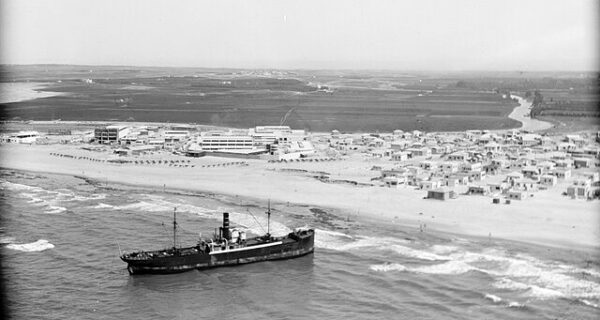
On April 11, 1909, a group of Jewish families gathered on a stretch of sand dunes just north of the ancient port city of Jaffa and carried out a modest but consequential act: they founded what would become the city of Tel Aviv. The event itself was simple—participants drew lots, using seashells marked with numbers and names, to divide parcels of land among themselves. Yet the moment marked a turning point in the history of Jewish settlement in Ottoman Palestine, representing both a practical response to overcrowding and unsanitary conditions in Jaffa and a broader ideological commitment to building a modern Hebrew-speaking city.
The founding group consisted of roughly 60 families associated with the Ahuzat Bayit society, a cooperative formed in 1906 with the aim of establishing a new Jewish neighborhood outside Jaffa. At the time, Jaffa was a densely populated and largely Arab city, with a growing Jewish minority that faced both economic pressures and limited space for expansion. Members of Ahuzat Bayit sought to create a planned suburb that would offer improved living conditions, including wider streets, better sanitation, and a more orderly layout than was typical of older urban centers in the region.
The lottery on April 11 symbolized both equality and aspiration. Each family received a plot, and the settlement began to take shape according to a structured urban plan. Early homes were modest, and the environment was harsh. The sandy terrain lacked infrastructure, and residents had to contend with limited water access and exposure to the coastal elements. Nevertheless, the founders were motivated by more than immediate material concerns. Their project was closely tied to the ideals of the Zionist movement, which emphasized not only the return of Jews to their historical homeland but also the creation of a new kind of society rooted in Hebrew culture and self-reliance.
Initially named Ahuzat Bayit, the settlement was renamed Tel Aviv in 1910. The name, drawn from the Hebrew translation of Theodor Herzl’s novel “Altneuland” (“Old-New Land”), captured the dual vision of reviving an ancient connection while building something distinctly modern. “Tel” referred to an archaeological mound, symbolizing the accumulated layers of history, while “Aviv,” meaning spring, evoked renewal and growth. Together, the name reflected the founders’ ambition to create a city that would bridge past and future.
Tel Aviv’s early development unfolded under Ottoman rule, but the city’s trajectory accelerated following the British capture of the region during World War I. Under the British Mandate, Tel Aviv expanded rapidly, fueled by successive waves of Jewish immigration, particularly from Europe. The city became a focal point for economic activity, cultural production, and political organization within the Yishuv, the pre-state Jewish community in the region.
Urban planning played a significant role in shaping Tel Aviv’s identity. In the 1920s, Scottish planner Patrick Geddes was commissioned to design a master plan that emphasized green spaces, residential neighborhoods, and a human-scale layout. The plan helped guide the city’s growth during a period of rapid population increase. By the 1930s, Tel Aviv had developed a distinctive architectural character, with many buildings constructed in the Bauhaus or International Style by architects trained in Europe. This concentration of modernist architecture would later earn the city recognition as a UNESCO World Heritage site.

Tel Aviv also emerged as a cultural center. Hebrew became the dominant language of daily life, reinforcing the broader Zionist goal of linguistic revival. The city hosted theaters, newspapers, and educational institutions, contributing to the development of a shared cultural and intellectual life among its residents. Economically, it became a hub for trade, industry, and finance, complementing the agricultural settlements that had characterized earlier phases of Jewish immigration.
The founding of Tel Aviv did not occur in isolation from the region’s broader political dynamics. Relations between Jewish and Arab communities in the area were complex and increasingly strained during the early 20th century, particularly as immigration increased and competing national movements took shape. Tel Aviv’s growth was thus intertwined with the larger historical processes that would eventually lead to the end of the British Mandate and the establishment of the State of Israel in 1948.