

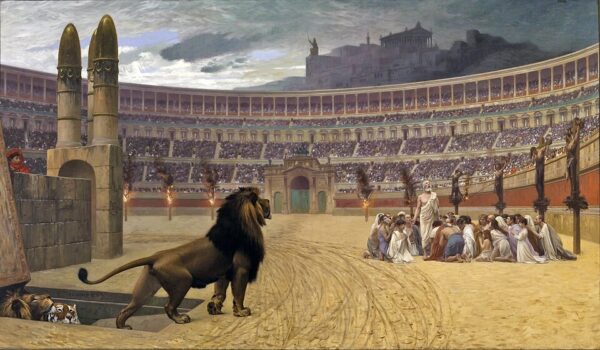
On April 30, 311, one of the most systematic and far-reaching campaigns of religious repression in the ancient world came to an abrupt and revealing end. The so-called Diocletianic Persecution—launched under the authority of the emperor Diocletian and carried forward by his imperial colleagues—had sought nothing less than the eradication of Christianity from the Roman Empire. Instead, it exposed the limits of imperial power, the resilience of a decentralized faith, and the beginnings of a transformation that would, within a generation, redefine the religious character of Rome itself.
The persecution, which began in 303, was not the first imperial action against Christians, but it was the most coordinated. A series of edicts ordered churches destroyed, scriptures burned, and Christian assemblies banned. Clergy were arrested, and later measures extended penalties to the broader Christian population, requiring public sacrifice to the traditional Roman gods on pain of imprisonment, torture, or death. The campaign reflected more than simple hostility; it was rooted in a broader effort by the tetrarchic regime to restore unity and stability to an empire strained by decades of crisis. Religious conformity, in this view, was not merely theological—it was political.
Yet the machinery of repression never operated uniformly across the empire. Enforcement varied widely depending on local officials and the disposition of co-emperors. In the Western provinces, under figures like Constantius Chlorus, the edicts were applied unevenly and often with restraint. In the East, however, under rulers such as Galerius, the persecution reached its most intense and sustained form. This unevenness would prove consequential, both in shaping the lived experience of Christians and in revealing the fragility of centralized authority across Rome’s vast territorial expanse.
By 311, the effort had failed on its own terms. Christianity had not been extinguished; if anything, it had grown more cohesive under pressure. Networks of believers adapted, meeting in secret, preserving texts, and elevating martyrs as symbols of steadfast faith. The attempt to impose religious uniformity had instead clarified the distinctiveness of Christian identity and deepened its internal solidarity. What had been envisioned as a restoration of order had become a prolonged demonstration of the empire’s inability to compel belief.
It was against this backdrop that Galerius—once among the most ardent proponents of the persecution—issued an edict of toleration, formally ending the campaign. The document, promulgated on April 30, 311, did not represent a sudden conversion to Christian doctrine, nor did it fully embrace religious pluralism in the modern sense. Rather, it was a concession grounded in political reality. Galerius acknowledged that the measures taken had failed to achieve their intended effect and instead produced disorder. Christians, he now permitted, could “exist again” and rebuild their places of assembly, provided they prayed for the welfare of the empire and its rulers.
The language of the edict is telling. It reframes toleration not as a recognition of rights, but as a pragmatic accommodation—an attempt to reintegrate a persistent and organized minority into the imperial system. Yet even in its limitations, the decree marked a decisive shift. The empire had moved, however cautiously, from coercion toward coexistence. The implications of that shift would soon become apparent.

Within two years, the Edict of Milan, issued under Constantine and Licinius, would go further, establishing a broader framework of religious liberty and restoring confiscated Christian property. But the turning point lies earlier, in 311, when the logic of persecution collapsed under the weight of its own contradictions. The Roman state, long accustomed to enforcing outward conformity, encountered a form of belief that could not be easily regulated, suppressed, or absorbed.