
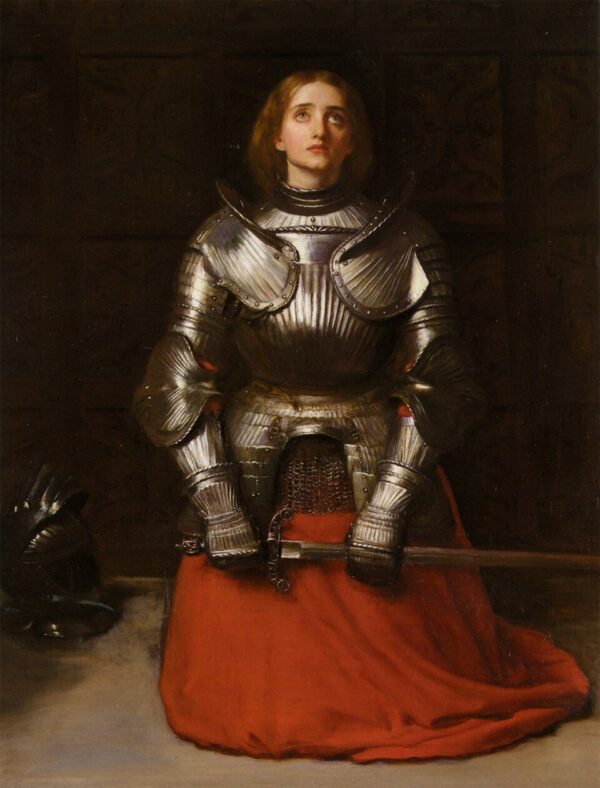
On May 30, 1431, in the Norman city of Rouen, the English-dominated tribunal that had spent months trying to destroy Joan of Arc finally delivered her to the fire. She was nineteen years old, a peasant girl from Domrémy who had become, in the space of two astonishing years, the living contradiction of English power in France: a military inspiration, a religious visionary, and a political symbol whose very existence threatened the fragile legitimacy of the English claim to the French crown. Condemned as a heretic, she was burned at the stake in Rouen’s old marketplace, where the public spectacle of punishment was meant to erase the force of her example. Instead, it made her immortal.
Joan’s death cannot be understood apart from the crisis of the Hundred Years’ War. France in the 1420s was not merely losing territory; it was losing the coherence of kingship itself. The English and their Burgundian allies controlled Paris and much of northern France, while the future Charles VII remained politically weakened, militarily uncertain, and uncrowned. Into that fractured world stepped Joan, claiming that heavenly voices had instructed her to rescue France and lead Charles to his coronation. To modern ears, that claim may sound mystical or implausible, but in the religious imagination of the fifteenth century, it carried a force that armies and courts could not easily dismiss.
Her achievement was not that she personally commanded armies in the modern sense, but that she gave the French cause a language of providence at the very moment it needed one. At Orléans in 1429, her presence helped reverse the momentum of the war. The lifting of the siege did more than save a city; it broke the aura of English inevitability. Her insistence that Charles be crowned at Reims restored to the Valois monarchy a sacred and public legitimacy that had been badly damaged by civil war, factional betrayal, and foreign occupation. In that sense, Joan was dangerous because she converted military resistance into a theology of national recovery.
That is why her captors could not treat her merely as a prisoner of war. After Burgundian forces captured her in 1430 and handed her over to the English, her enemies staged an ecclesiastical proceeding designed to sever her from divine authority. The trial in Rouen began in January 1431, and its charges included heresy and related accusations meant to portray her voices, clothing, and defiance as evidence of spiritual disorder rather than sanctity.
The tribunal’s purpose was political as much as religious. If Joan’s visions were fraudulent, then her victories were not signs of God’s favor. If she was a heretic, then Charles VII’s coronation under her influence could be morally tainted. Her judges were therefore trying to burn more than a girl. They were trying to burn the meaning she had given to the French cause.

Joan’s execution at Rouen was intended to humiliate her, yet the image that survived was not of disgrace but of witness: a young woman standing before clerics, soldiers, and townspeople, refusing at the end to become what her judges required her to be. Later generations would reinterpret her through many lenses—Catholic saint, French patriot, nationalist icon, feminist symbol, peasant visionary—but all of those later Joans began with the same historical fact: the authorities who condemned her could not control what her death would mean.