
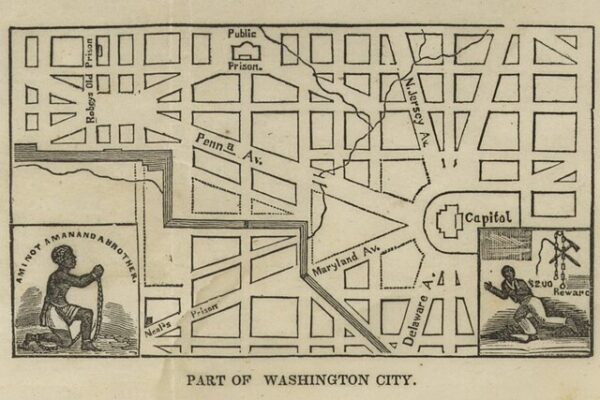
On April 16, 1862, in the midst of a war that had already begun to transform the political and moral landscape of the United States, President Abraham Lincoln signed into law the District of Columbia Compensated Emancipation Act, ending slavery in the nation’s capital. Though limited in geographic scope, the measure marked a decisive step in the federal government’s gradual movement from preserving the Union to redefining it on free-soil principles.
The law applied only to Washington, D.C., a jurisdiction under direct congressional authority, which made it uniquely suited as a testing ground for emancipation. Unlike the border states—where slavery remained protected by state law and delicate political alliances—Congress could act in the District without directly confronting the constitutional barriers that still constrained broader abolition. In that sense, the act was both cautious and consequential: cautious in its limited reach, consequential in its unmistakable signal.
The structure of the legislation reflected the political realities of early 1862. Rather than immediate, uncompensated abolition, it provided for the emancipation of enslaved people with financial compensation to loyal slaveholders. Congress allocated up to $1 million to reimburse owners, with individual payments capped at $300 per enslaved person. The act also included a provision offering voluntary colonization funds—encouraging freed individuals to emigrate abroad, a feature that revealed the persistence of older assumptions about race and coexistence even within antislavery policy.
Approximately 3,100 enslaved men, women, and children were freed under the law. Petitions submitted by former slaveholders, along with records of those emancipated, survive as a detailed bureaucratic archive of the transition from bondage to freedom. For those liberated, the change was immediate and profound, even as the broader war continued to determine the fate of millions still enslaved across the Confederacy and the border states.
Lincoln’s support for compensated emancipation in the District had deeper roots in his long-standing belief that gradual, compensated abolition might serve as a politically viable path forward. He had previously urged similar policies on slaveholding states that remained in the Union, arguing that federal compensation could ease resistance while hastening the end of slavery. Those proposals largely failed to gain traction. Yet in Washington, where Congress held direct authority, the idea could be implemented—offering Lincoln both a symbolic victory and a practical precedent.
The timing of the act was not incidental. By April 1862, the war had exposed the inadequacy of policies that treated slavery as peripheral to the conflict. Enslaved people were fleeing to Union lines in increasing numbers, forcing military and political leaders to confront the institution not as an abstract issue but as an operational reality. Measures such as the Confiscation Acts had already begun to erode slaveholders’ claims to human property. The District’s emancipation law went further, converting wartime disruption into formal legal change.

In retrospect, the act can be seen as a bridge between earlier, limited antislavery measures and the more sweeping transformations that would follow. Just five months later, Lincoln would issue the preliminary Emancipation Proclamation, redefining the war as a struggle not only for Union but for freedom. While the proclamation applied only to areas in rebellion and did not immediately free all enslaved people, it marked a far more expansive use of executive authority than the District law. Still, the April 1862 act demonstrated that emancipation was no longer theoretical—it could be enacted, administered, and enforced.
The District of Columbia Compensated Emancipation Act also carried a symbolic weight that extended beyond its immediate effects. By abolishing slavery in the capital, the federal government removed a glaring contradiction at the heart of the Union war effort. A republic claiming to fight for its survival could no longer tolerate human bondage in the shadow of its own institutions.