
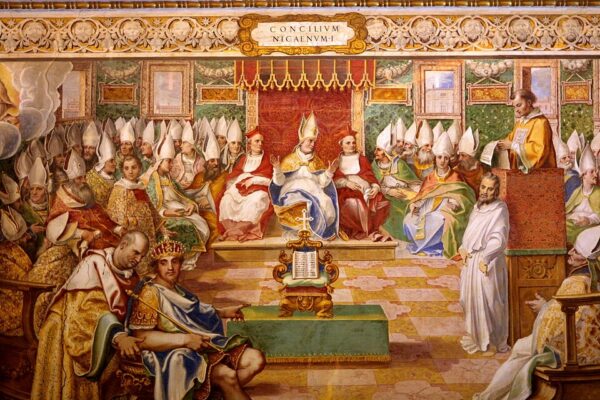
On May 20, 325, the First Council of Nicaea formally opened, marking one of the most consequential gatherings in the history of Christianity. Convened by the Roman emperor Constantine, the council brought together bishops from across the empire to settle a theological dispute that had become not merely a church controversy, but a threat to imperial unity.
The central question concerned the nature of Jesus Christ and his relationship to God the Father. The dispute had been sharpened by Arius, a priest from Alexandria, who argued that the Son of God was not co-eternal with the Father but was instead a created being. Arius did not deny Christ’s greatness or divine role, but his teaching implied a hierarchy within the Godhead: the Father alone was eternal in the fullest sense, while the Son had a beginning.
To many church leaders, especially Alexander of Alexandria and the young deacon Athanasius, this teaching struck at the heart of Christian worship and salvation. If Christ was not truly God, they argued, then the Christian claim that God had entered history to redeem mankind was weakened. The issue was not an abstract quarrel over language. It concerned the identity of Christ, the meaning of redemption, and the boundaries of orthodox belief.
Constantine’s role was decisive. Having legalized Christianity through the Edict of Milan in 313 and increasingly favored the church, he wanted religious peace within the empire. The Roman state had long used religion as a source of public order, and Constantine saw Christian division as dangerous to the stability he was trying to restore after years of civil war. By calling bishops to Nicaea, located in present-day Turkey, he placed imperial authority behind the effort to resolve the dispute.
The council drew hundreds of bishops, mostly from the eastern half of the empire, though representatives from the West also attended. It was the first council to claim authority over the whole church, which is why it became known as the first ecumenical council. Its proceedings symbolized a dramatic transformation: less than three centuries after Christians had been persecuted by Roman authorities, their leaders were now meeting under imperial sponsorship.

The council’s most famous achievement was the formulation of the Nicene Creed. Its key phrase declared the Son to be “of one substance” with the Father, using the Greek term homoousios. That word became the dividing line between Nicene orthodoxy and Arian theology. By affirming that Christ was not a lesser divine being but fully God, the council established a doctrinal foundation that would shape Christian theology for centuries.
Nicaea also addressed other matters, including the date of Easter and various questions of church discipline. But its lasting importance lies in its definition of Christian orthodoxy and its model of church-wide decision-making. The council did not end the Arian controversy immediately. In fact, the dispute continued for decades, with emperors, bishops, and regional churches taking different positions. Athanasius himself would spend much of his life defending the Nicene position, often at great personal cost.