

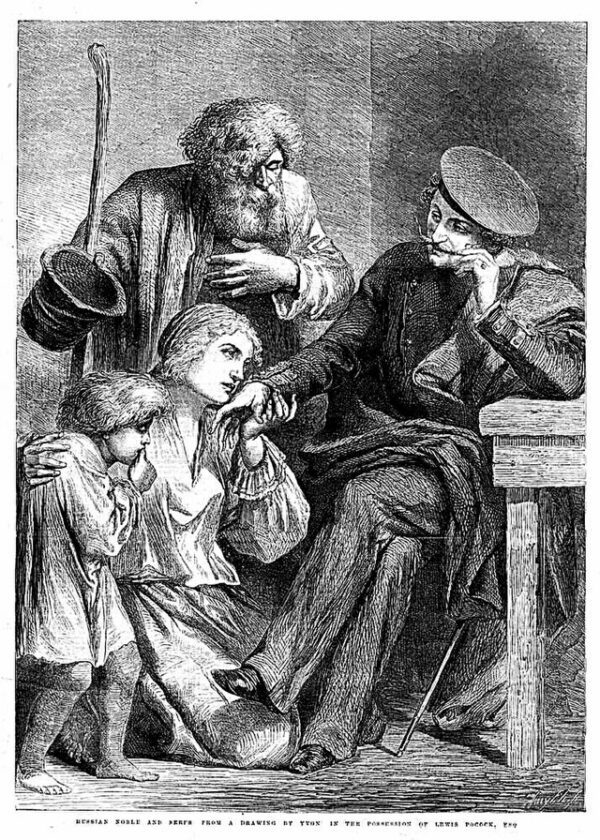
On March 3, 1861, amid the brittle stillness of a winter-bound empire, Alexander II signed the Emancipation Manifesto and, with a flourish of imperial ink, detonated one of the oldest social arrangements in Europe. More than 20 million serfs—peasants legally bound to noble estates—were declared free. The decree did not merely revise statute; it reconfigured the moral and economic foundations of Russia itself. An autocracy that had long defined stability as immobility was now attempting reform without surrender, transformation without revolution.
To modern eyes, Russian serfdom invites easy comparison to American slavery, yet the institutions diverged in form even as they shared the common grammar of unfreedom. Russian serfs were typically tied to land rather than sold as movable property; they possessed customary rights within village communes; they could not ordinarily be severed from the soil that defined their labor. But these distinctions did not translate into liberty. Serfs required permission to marry, to travel, to alter their economic condition. They owed labor dues or payments to landlords whose authority extended deep into daily life. Custom hardened into constraint; obligation calcified into inheritance.
By the mid-nineteenth century, the system had become not merely unjust but inefficient. Russia’s humiliating defeat in the Crimean War (1853–1856) stripped bare the empire’s structural weaknesses—its inadequate railways, its industrial backwardness, its cumbersome bureaucracy. A modern state could not be sustained by medieval arrangements. Military reform required social mobility; economic development required a freer labor market. The old order was not only morally suspect—it was strategically untenable.
Alexander understood this with unusual clarity for a Romanov. “It is better to abolish serfdom from above,” he warned the nobility, “than to wait until it begins to abolish itself from below.” The remark was less humanitarian flourish than political diagnosis. Peasant unrest simmered across the countryside; rumors of emancipation had circulated for years. Reform, in this calculus, was preemption.
The Manifesto granted former serfs personal freedom and the rights of legal persons: to marry without landlord consent, to own property, to conduct business, to seek redress in courts. Yet emancipation was framed as a settlement rather than a rupture. Land—the essential economic foundation of peasant life—would be distributed through village communes, the mir, which would collectively assume responsibility for redemption payments. The state compensated landowners upfront and then required peasants to repay the treasury over decades, often at rates that ensured long-term indebtedness.
Here lay the paradox. Freedom was proclaimed; dependency was recalibrated. In many regions, landlords retained the most fertile acreage, leaving peasants with fragmented strips insufficient for growing families. The mir, though protective in theory, could also become an instrument of constraint, redistributing land periodically and limiting individual mobility. Redemption payments—stretching as long as 49 years—converted liberation into obligation. The chains were lighter, perhaps, but they had not vanished.
Historians continue to debate whether 1861 should be understood as a cautious modernization or a missed revolutionary opportunity. Some emphasize the enormity of the act: no other European power had attempted to free so vast a rural population through centralized decree. Others note that the compromise entrenched grievances that would later fuel radicalism. The industrial working class that emerged in the late nineteenth century—crowded into factories in Moscow and St. Petersburg—was populated in large measure by former serfs or their children. Emancipation, in this sense, helped generate the very social forces that would destabilize the autocracy in 1905 and 1917.

Alexander earned the title “Tsar Liberator,” yet reform proved perilous terrain. His reign extended beyond emancipation to judicial overhaul, local self-government through the zemstvos, and military restructuring. Each reform loosened the rigidities of Nicholas I’s reign; none surrendered the principle of autocratic supremacy. Reform and repression coexisted in uneasy tandem. In 1881, the emperor who had freed the serfs was assassinated by revolutionaries—a grim testament to the volatility unleashed by partial transformation.
The Emancipation Manifesto did not create equality. It did not dissolve rural poverty or reconcile peasant expectation with aristocratic privilege. But it did fracture a social order that had endured for centuries. On that March day in 1861, Russia acknowledged—however reluctantly—that power anchored solely in inherited bondage could not sustain a modern empire. The autocracy sought to reform itself without ceasing to be itself. History would reveal how unstable that balance truly was.