

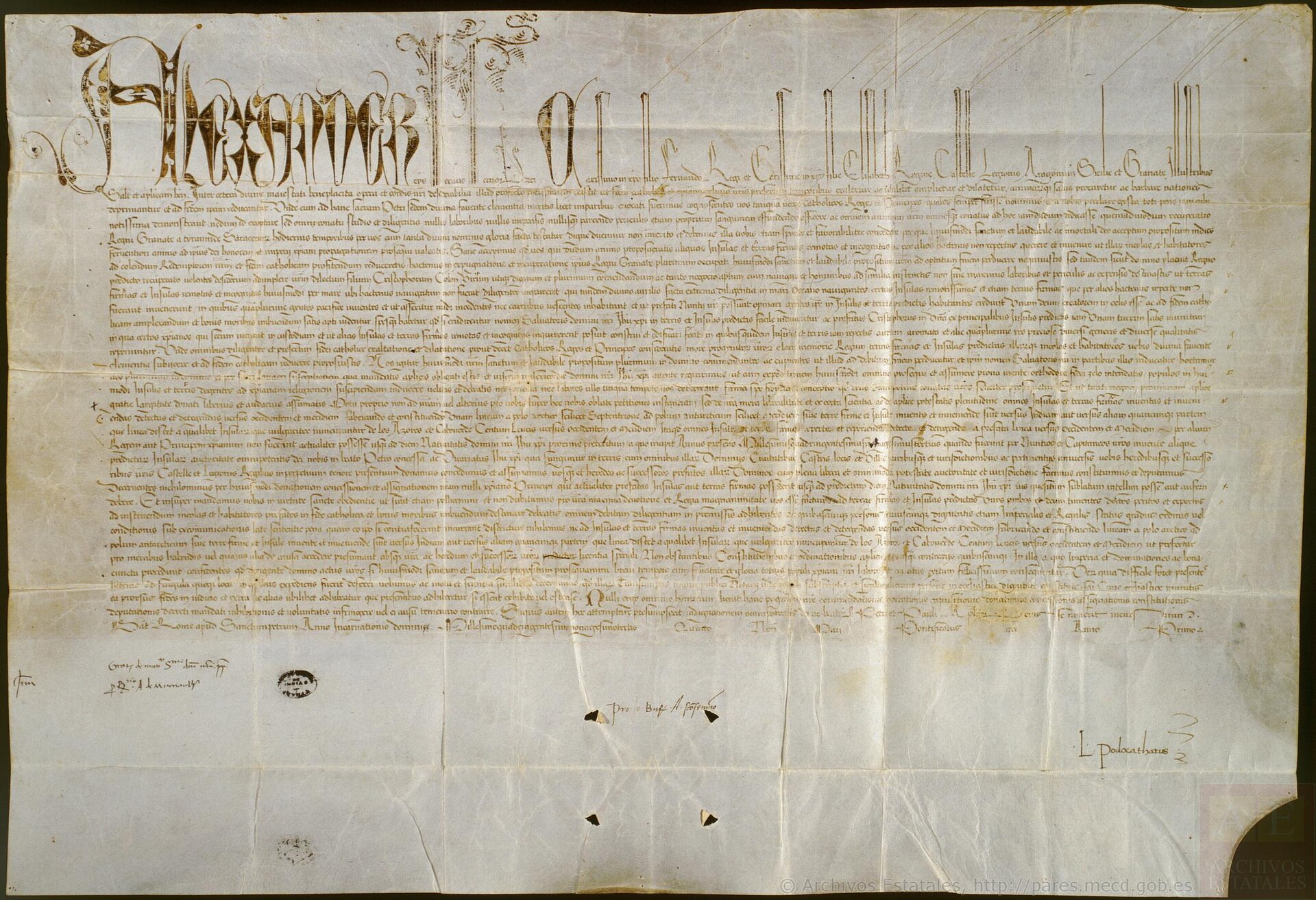
On May 4, 1493, Pope Alexander VI issued the papal bull Inter caetera, an expansive declaration that sought to impose juridical and theological order on the newly encountered Atlantic world. Produced in the immediate aftermath of Christopher Columbus’s first voyage, the document reflects a moment in which discovery outpaced institutional frameworks, forcing European authorities to translate geographic novelty into recognizable categories of law, sovereignty, and mission. The bull thus stands not merely as a diplomatic instrument, but as an early articulation of how Christendom would conceptualize authority beyond its traditional boundaries.
At the center of Inter caetera was the establishment of a Line of Demarcation, an imagined longitudinal boundary drawn approximately 100 leagues west of the Azores and Cape Verde Islands. Territories lying west of this line were granted to the Spanish crown, while those to the east were reserved to Portugal. This division functioned as a preventative mechanism, designed to avert conflict between the two preeminent maritime powers of the late fifteenth century, each of which had invested heavily in exploration and sought formal recognition of its claims. For the Spanish monarchs, Ferdinand and Isabella, the bull represented both validation of their sponsorship of Columbus and a strategic consolidation of their position within an emerging imperial framework.
The authority underlying this division derived from a late medieval conception of papal jurisdiction that extended, at least in theory, across the entirety of Christendom and into lands inhabited by non-Christians. As pope, Alexander VI asserted the capacity to allocate such territories to Christian rulers, not as an act of arbitrary distribution, but as part of a broader mandate to advance the Christian faith. The language of the bull makes this explicit, framing territorial grants as instruments of evangelization and placing upon Spain a corresponding obligation to convert indigenous populations. This fusion of religious obligation and territorial claim would become a defining feature of European imperial expansion, providing both a moral vocabulary and a justificatory structure for conquest.
Portugal’s response, however, reveals the contingent nature of papal authority in practice. Having spent decades developing maritime routes along the African coast and into the Indian Ocean, the Portuguese crown viewed the initial demarcation as a threat to its commercial and strategic interests. Diplomatic negotiations between the two kingdoms resulted in a revision of the boundary through the Treaty of Tordesillas, which moved the line further west. This adjustment, undertaken within a year of the original bull, underscores the extent to which papal decrees were subject to modification through political bargaining, even as they retained symbolic and legal significance.
The longer-term implications of Inter caetera extend beyond its immediate diplomatic function. By endorsing the partition of overseas territories without reference to existing political or social structures, the bull contributed to the development of a legal framework that subordinated indigenous sovereignty to European claims. The assumption that non-Christian lands could be assigned by external authority helped to normalize practices of conquest, conversion, and extraction, embedding them within a broader conception of legitimate rule. In this sense, the document did not merely respond to discovery; it shaped the terms under which discovery would be interpreted and acted upon.

Yet the durability of this framework was limited. As other European powers, particularly England and France, entered the field of exploration, they rejected the premise that papal authority could determine territorial rights beyond Europe. The Line of Demarcation, while influential in the Iberian context, gradually lost its binding force as competing doctrines of sovereignty and international law emerged. What remained was less a fixed boundary than a precedent: an early attempt to reconcile expansion with order through a synthesis of religious authority and political negotiation.